
Previous
Next
Index


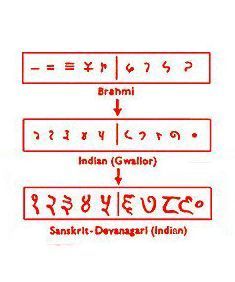
Evolution of Arabic (Roman) Numerals from India

A close investigation of the Vedic system of mathematics shows that it was much more advanced than the mathematical systems of the civilizations of the Nile or the Euphrates. The Vedic mathematicians had developed the decimal system of tens, hundreds, thousands, etc. where the remainder from one column of numbers is carried over to the next. The advantage of this system of nine number signs and a zero is that it allows for calculations to be easily made. Further, it has been said that the introduction of zero, or sunya as the Indians called it, in an operational sense as a definite part of a number system, marks one of the most important developments in the entire history of mathematics. The earliest preserved examples of the number system which is still in use today are found on several stone columns erected in India by King Ashoka in about 250 B.C.E. [4 ] Similar inscriptions are found in caves near Poona (100 B.C.E.) and Nasik (200 C.E.). [5] These earliest Indian numerals appear in a script called brahmi.

After 700 C.E. another notation, called by the name "Indian numerals," which is said to have evolved from the brahmi numerals, assumed common usage, spreading to Arabia and from there around the world. When Arabic numerals (the name they had then become known by) came into common use throughout the Arabian empire, which extended from India to Spain, Europeans called them "Arabic notations," because they received them from the Arabians. However, the Arabians themselves called them "Indian figures" (Al-Arqan-Al-Hindu) and mathematics itself was called "the Indian art" (hindisat).

Evolution of "Arabic numerals" from Brahmi
(250 B.C.E.) to the 16th century.

Mastery of this new mathematics allowed the Muslim mathematicians of Baghdad to fully utilize the geometrical treatises of Euclid and Archimedes. Trigonometry flourished there along with astronomy and geography. Later in history, Carl Friedrich Gauss, the "prince of mathematics," was said to have lamented that Archimedes in the third century B.C.E. had failed to foresee the Indian system of numeration; how much more advanced science would have been.
Prior to these revolutionary discoveries, other world civilizations-the Egyptians, the Babylonians, the Romans, and the Chinese-all used independent symbols for each row of counting beads on the abacus, each requiring its own set of multiplication or addition tables. So cumbersome were these systems that mathematics was virtually at a standstill. The new number system from the Indus Valley led a revolution in mathematics by setting it free. By 500 C.E. mathematicians of India had solved problems that baffled the world's greatest scholars of all time. Aryabhatta, an astronomer mathematician who flourished at the beginning of the 6th century, introduced sines and versed sines-a great improvement over the clumsy half-cords of Ptolemy. A.L. Basham, foremost authority on ancient India, writes in The Wonder That Was India,

Medieval Indian mathematicians, such as Brahmagupta (seventh century), Mahavira (ninth century), and Bhaskara (twelfth century), made several discoveries which in Europe were not known until the Renaissance or later. They understood the import of positive and negative quantities, evolved sound systems of extracting square and cube roots, and could solve quadratic and certain types of indeterminate equations." [6] Mahavira's most noteworthy contribution is his treatment of fractions for the first time and his rule for dividing one fraction by another, which did not appear in Europe until the 16th century. next