
A brief look into the history and essential meaning of the ISKCON and Gaudiya Math parampara.
(The following article has been written to counteract the accusation that Srila Bhaktisiddhanta Saraswati Prabhupada and his disciples and grand disciples are not in the Parampara of Srila Bhaktivinode Thakura. This accusation has recently appeared on the internet and therefore our response is being posted on VNN. For the most part the western community of devotees are unaware of the early histories surrounding the preaching movement of Srila Bhaktivinode Thakur, Srila Bhaktisiddhanta Saraswati Thakur, and the types of opposition which they encountered. We hope this article will better aquaint the devotees with the facts and also send a message to the anti-party that we are not so uninformed as they would like to think - nor are we likely to depart from the siddhanta of Saraswati Thakur in favor of the imitationist process)
It so happens that from time to time over the centuries the movement of Sri Caitanya Mahaprabhu has come under strong criticism and ridicule by those who are either uninformed about the actual practice of pure devotional service or by those who are overtly envious of the Supreme Lord and His pure devotees, the anti-party.
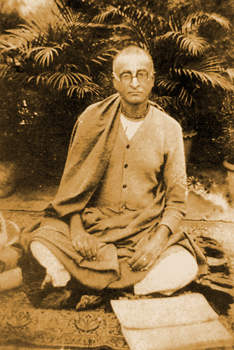
During the 1920s and 30s as well as recently as 1998 the anti-party has revived a certain propaganda that Srila Bhaktisiddhanta Saraswati Thakur is not in the parampara of Bhaktivinode Thakur. It is the suggestion of the anti-party that Saraswati Thakur had no guru connection with Bhaktivinode whatsoever. Since Gaura Kishore dasa Babaji Maharaja was the diksa-guru (one who gives guru-mantra to gopal-mantra and kama-gayatri) of Saraswati Thakur his parampara, they say, should be traced to the Adwaita-parivad (disciplic succession in the family of Adwaita) and not to Bhaktivinode Thakur whom they say is in the Nityananda-parivad. It is also their thinking that Bhaktivinode Thakur did not regard Jagannatha das Babaji as his substantial guru (siksa-guru).
Furthermore it is the contention of the anti-party that since Saraswati Thakur did not receive siddha-pranali from Bhaktivinode Thakura he should not be considered his true follower and one who does not receive siddha-pranali, they say, cannot attain Vraja-bhakti. The anti-party is so strong on this point that they even go so far as to say that Bhaktivinode Thakur was not pleased with Saraswati Thakur due to Saraswati Thakur having wholesale rejected Bipin Bihari Goswami (the diksa-mantra/ pancaratrika-mantra-guru) of Bhaktivinode Thakur. Therefore they say that Bhaktivinode did not give siddha-pranali to him, as if rejecting Saraswati Thakur.
It is a fact that Bhaktivinode sent Saraswati Thakur to Gaura Kishore das Babaji for initiation and it is universally accepted that Babaji was a siddha-mahatma. The fact that Bhaktivinode did send Saraswati to Gaura Kishore is proof that he saw in the Babaji a higher conception than he found in his own diksa-guru - otherwise he could easily have corrected Saraswati and sent him to Bipin Bihari Goswami. But he didn't.
The anti-party draws their line of disciplic succession from Bipin Bihari Goswami to Bhaktivinode Thakur, to Lalit Prasad Thakur (the brother of Bhaktisiddhanta) to Gadadhara-pran and a few others.
The word "anti-party" has been chosen by Saraswati Thakur and his disciples to best describe the so-called disciplic succession going under the name of siddha-pranali because of their actually being in direct opposition to the teachings of Sri Caitanya Mahaprabhu. There is such a thing as siddha-pranali and Krishna das Kaviraja Goswami has described siddha-pranali in his commentary to Krishna-karnamrta. He says that both siddha-pranali and chanting the holy name are bona fide, but Kaviraja concludes by saying that of the two - the process of taking the name of Krishna is superior. One becomes pure by chanting the name without offense and the holy name itself reveals the astakala-lila (eight-fold pastimes), being nondifferent from Krishna and His lilas. (This reference available at Caitanya Research Institute, Calcutta)
The first doubt raised by the anti-party is that the actual guru of Bhaktivinode Thakur was Bipin Bihari Goswami and not Jagannatha dasa Babaji. They say that to consider Jagannatha das Babaji as the guru of Bhaktivinode is an offense. They consider this so because Bhaktivinode Thakur accepted diksa from Bipin Bihari Goswami in 1881 and he never received any such initiation from Jagannatha Dasa Babaji. Thus the anti-party wishes to discredit the parampara line as shown by Saraswati Thakur in his song "Guru Parampara" and simultaneously they wish to establish their own line as the true parampara of Bhaktivinode Thakur.
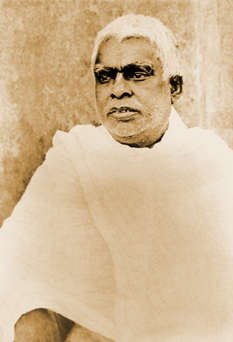
Bhaktivinode Thakur went on pilgrimage to Vrindavana in 1881 at which time he met Jagannatha Dasa Babaji. The Thakur received many spiritual instructions from Babaji Maharaja and the Thakur accepted him as his substantial guru (siksa-guru). Bhaktivinode has referred to Jagannatha Dasa Babaji as vaisnava-sarvabhaumah, the most revered and worshipable Vaishnava:
gauravirbhava-bhumes tvam, nirdesta saj-jana-priyah
vaisnava-sarvabhaumah, sri-jagannathaya namah
"I offer my respectful obeisance to Jagannatha Dasa Babaji Maharaja who is respected and worshipped by the entire Vaishnava community and who discovered the birth place where Sri Caitanyadeva appeared."
This raises another interesting point: With the help of Jagannatha das Babaji, Bhaktivinode was able to discover the place of Mahaprabhu's appearance. Simultaneously it was declared that the so-call Yoga-pitha at Navadwip on the other side of the Ganges was false. Many cast Goswamis objected to the site at Mayapur being the original site. Bipin Bihari Goswami at that time rejected Bhaktivinode Thakur for preaching an untruth (mithyapracara) and he even published his rejection of Bhaktivinode's preaching in a small newspaper of his own called Gaurangasevaka Patrika in 1919. One could say at this point - that at least that they did not see eye to eye or that their feelings for placing distance in their relationship with each other was mutual - indeed a difficult relationship to maintain between "guru and disciple." (The Gaurangasevaka Patrika and article available at Caitanya Research Institute, Calcutta.)
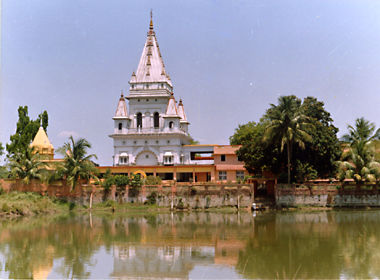
Therefore Bhaktivinode turned over the Yoga Pitha at Mayapur to Saraswati and nobody else because he knew that only he had the strength, realization and sastric pramana (evidence) to hold the sacred ground against the sahajiya and Brahmin community. It is also interesting to note that although Bipin Bihari Goswami rejected the idea that Yoga Pitha was in Mayapur - the modern day followers of Lalit Prasad, nonetheless, accept Yoga Pitha in Mayapur and not the so-called Yoga Pitha in Navadwip.
For many years Saraswati Thakur saw the exchanges between Jagannatha Dasa Babaji and Bhaktivinode at times when the two lived together at Svananda-sukhada-kunja in Nadia for many years. We do not find any association of Bhaktivinode Thakur with Bipin Bihari Goswami except for a short time in the village of Narail, East Bengal and this does not include any reference to the latter instructing Bhaktivinode in the matter of pure devotional service.
It is true, as the anti-party says, Saraswati Thakur did not have very high regard for Bipin Bihari Goswami - he certainly did not consider him to be the Guru of Bhaktivinode Thakur. Saraswati Thakur as a small child (7 years old) was present when Bhaktivinode Thakur received diksa mantras from Bipin Bihari Goswami and from the outset Saraswati Thakur was critical of the Goswami. When Bhaktivinode offered his obeisances to the Goswami - the Goswami attempted to place his foot on the head of the Thakur - the child remarked, "Do you think that you have such spiritual power that you can put your foot on the head of Srila Bhaktivinode?"
There is another short story: Once a celebrated sahajiya came to see Bhaktivinode at his residence. The sahajiya was a gentleman but nonetheless a sahajiya. Saraswati was a young boy at the time. When he saw his father (Bhaktivinode) talking with that gentleman he simply offered obeisances at a distance and got up and went away. Seeing this the gentleman inquired, "Was that your son -why does he offer obeisances and go away?" Bhaktivinode replied in a happy style, "He has taken a vow not to come within one hundred metres of a sahajiya."
We must mention here that both Bhaktivinode Thakur and Saraswati Thakur have been accepted by many great devotees and scholars as liberated souls who appeared in this world by the divine arrangement of Krishna. They were not a pair (father and son) of this world as the mundane bhaktas (prakrta-sahajiyas) think - rather they were eternal residents from Goloka Vrindavana; namely Kamala-manjari and Nayana-mani-manjari respectively. Therefore from the beginning of their lives they both showed exceptional qualities and characteristics which are to be attributed only to pure devotees and liberated souls.
For example Bhaktivinode Thakur was preaching the process of pure devotion; writing and printing books such as Krishna-samhita and Kalyana Kalpataru (both revered devotional works) before he even met his so-called Guru, Bipin Bihari Goswami - something which is highly unusual, even unheard of - unless that is, one is already a liberated soul. Similarly Saraswati Thakur manifested himself as a pure Vaishnava from his earliest childhood. He was quick to catch the essence of the scripture and he especially showed a keen ability to distinguish between real bhajan and that of the sahajiyas (imitationists). We will not go into greater detail regarding their many transcendental pastimes, for many biographies have been written on this subject - it will suffice to say that both Bhaktivinode and Saraswati Thakur were liberated souls who came down to this world from Krishna's personal entourage to establish the essence of pure devotional service.
Bhaktivinode Thakur did for sometime show formal respect to Bipin Bihari Goswami but when the Goswami disrespected Raghunatha dasa Goswami, the Thakur distanced himself even more from Bipin Bihari. In essence the details of this incident show that like many cast Goswamis in Orissa, Bengal, Vrindavana and Radha Kunda - Bipin Bihari Goswami also thought that he could give blessings to Raghunatha dasa Goswami, the prayojana-acharya, because Das Goswami was from a "lower cast" or so he mistakenly thought. It appears that Lalit Prasad Thakur overlooked the stressful relation that had evolved between Bhaktivinode and Bipin Bihari over the issue of Yoga-Pitha being at Mayapur and also that of Ragunatha dasa Goswami in favor of the formal arangement of diksa. It does not appear, in spite of his vast learning, that he was able to catch the essence of the teachings of Bhaktivinode Thakur.
It is also known that Bipin Bihari mixed very freely with the degraded sections of Bengal society and associated with anti-Vedic philosophers like the Brahma Samaja. Even after his return to Vaisnavism he continued bad habits like smoking etc. - thus Saraswati Thakur, who was himself very strict in principles, saw this as a sign of lower Vaisnava adhikari (kanistha-adhikari) although Bhaktivinode Thakur remained somewhat unspoken on the issue.
In 1911 there was an assembly of scholars held in Medinpur (Bengal) wherein the topic of debate was to be "Brahmins and Vaishnavas." Bipin Bihari Goswami was present at that assembly and, as already known, he would side with the Brahmin community in the platform that Brahmin Vaishnavas were automatically superior to non-Brahmin Vaisnavas, due to a Brahmin being born in a higher cast. Bhaktivinode Thakur was also invited to attend that assembly. The conflict between he and Bibin Bihari was destined. Bhaktivinode Thakur - not wanting to take the position of confronting and attempting to defeat his "diksa-guru" in a public forum declined to attend the meeting on the plea of bad health. In his place he sent Saraswati Thakur (age 37) to represent pure Gaudiya Vaisnava-siddhanta in the line of Sri Rupa and Raghunatha das Goswami as per the teachings of Mahaprabhu.
 In that assembly Saraswati Thakur prevailed in the debate and established to the satisfaction of the majority of that assembly that a pure Vaishnava, regardless of his birth was the topmost human being due to his unalloyed love for Godhead. The news of this was very pleasing to Bhaktivinode Thakur. The lecture (Brahmana O Vaisnavera Taratamya Visayaka Siddhanta - The Conclusion Concerning the Comparison of Brahmanas and the Vaisnavas) was published in a book in English called "Brahmins and Vaisnavism." (Also available at Caitanya Research Institute, Calcutta)
One might ask why Bhaktivinode Thakur took initiation from Bipin Bihari Goswami in the first place, for the question naturally arises whether or not the Goswami was actually a pure devotee (perfected soul)?
During those days in India all the "recognized Gaudiya Vaisnavas" were initiated into one of the main parivads such as Adwaita and Nityananda-parivads. Everyone was expected to wear tilok and neck beads corresponding to his particular parivad. Since he had not taken initiation in any such parivad, Bhaktivinode did not wear the external markings of a Gaudiya Vaishnava. It so happened that some persons who had no real eyes to see him would sometimes consider Bhaktivinode to be a materialist and so forth and thus commit vaisnava-aparadha. Seeing this situation Bhaktivinode considered accepting the external markings of a Vaishnava which he must receive from a guru. He longed to meet a bona-fide guru who could inspire him but as Bhaktivinode later wrote, "But I did not obtain one." Later in a dream the Thakur got some direction from Mahaprabhu and he accepted Bipin Bihari Goswami.
The followers of Lalit Prasad Thakur contend that this is proof that Bipin Bihari was a perfected soul, otherwise Mahaprabhu would not have given direction to Bhaktivinode to accept him as guru. At this point the anti-party suggests that "could Mahaprabhu have made a mistake?" - thus they wish to indicate that Bhaktivinode Thakur received a siddha-guru (sat-guru) by the arrangement of Mahaprabhu Himself and not simply a formal connection for decorum's sake. We couldn't disagree more.
Mahaprabhu Himself took sannyasa in the mayavadi sampradaya for the same reason—for decorum's sake only. And after that the Lord continued His preaching mission of nama-sankirtana. The situation of Bhaktivinoda was similar--his mission was to preach-he had come down to this world with that purpose.
At the time of his initiation Bhaktivinoda received the pancaratric mantras; guru-mantras, gopala-mantra, and kama-gayatri. It is interesting to note here that Bhaktivinoda received those mantras, which are offered as a samskara in place of the Vedic diksa-samskara and which are primarily meant for Deity worship following the system of panca-samskara (tapa, pundra, nama, mantra, and yaga). It is clear also in studying the life of Bhaktivinoda Thakura through his writings that he did not imbibe any of the conceptions of Bipin Bihari Goswami. Factually the two, Bhaktivinoda Thakura and Bipin Bihari were distanced from each other from the very beginning--although it can be said that Bhaktivinoda did continue to show the Goswami formal respect. Of course the anti-party says that Bhaktivinoda received siddha-pranali (ekadasa-bhava) from Bipin Bihari Goswami. Nonetheless, this does not establish the anti-party's procedure of giving siddha-pranali to the unqualified.
Such respect for the Goswami was not so visible in Saraswati Thakura. In fact in later years Saraswati Thakura re-initiated (hari-nama, mantra-diksa, and sannyasa) a prominent disciple of Bipin Bihari Goswami, who became know as Bhaktivivek Bharati Maharaja. There is no hiding the truth - Saraswati Thakura totally rejected the idea that Bipin Bihari Goswami was a spiritual preceptor of Bhaktivinoda and we are also accepting the same conclusion. The brother of Saraswati Thakura (Lalita Prasada Thakura) however accepted just the opposite.
After the disappearance of Bhaktivinoda Thakura, Saraswati Thakura and Lalita Prasada Thakura started a mission together in Calcutta called Bhaktivinoda Asan at Ultadanga St. In a very short time their difference in conception/vision about Bhaktivinoda arose and they parted ways. Saraswati Thakura used to say, "My brother sees Bhaktivinoda as Babu (father) but I see him as the delegation of Radha." This statement reveals that Saraswati Thakura obviously considered that Lalita Prasada Thakura placed more importance on form than on substance and that he also had no proper conception of the eternal divinity of Bhaktivinoda.
The disciples of Lalita Prasada Thakura have said that their guru has written extensively on the differences between he and Saraswati Thakura, but none of those manuscripts have ever been printed. On the other hand Saraswati Thakura wrote long and printed his manuscripts to spread the glories of Sri Caitanya Mahaprabhu all over the world. This reflects a seemingly distinct character difference between the two brothers — one was prone to fault the other, while the other dedicated his life solely for the service of Mahaprabhu.
Although Saraswati Thakura did receive mantra-diksa from Gaura Kisora dasa Babaji Maharaja (1900) he also accepted Bhakti-vinoda Thakura as his substantial guru. It should be mentioned here also that Bhaktivinoda Thakura gave mantras for worshipping the Deity in 1881 and harinama-diksa to Saraswati Thakura in 1886. The following is a letter (1910) from Bhaktivinoda Thakura to Saraswati Thakura wherein Bhaktivinoda gives Saraswati essential spiritual instructions, thus demonstrating that he was indeed his substantial (siksa) guru.
Saraswati!
People of this world who are proud of their own aristocratic birth cannot attain real aristocracy. Therefore they attack the pure Vaisnava, saying, 'They have taken birth in low-class families because of their sins.' Thus they commit offenses. The solution to the problem is to establish the order of daiva-vareacrama-dharma--something you have started doing; you should know that to be the real service to the Vaisnava. Because pure devotional conclusions are not being preached, all kinds of superstitions and bad concepts are being called devotion by such pseudo sampradayas as sahajiya and ativaoe. Please always crush these anti-devotional concepts by preaching pure devotional conclusions and by setting an example through your personal conduct.
Please make great effort so you can start parikrama of Sridhama Navadvipa as soon as possible. It is by those actions that everyone in this world will receive Krishna bhakti. Please try very hard to make sure that the service to Sri Mayapur will become a permanent thing and will become brighter and brighter every day. The real service to Sri Mayapur can be done by acquiring printing presses, distributing devotional books, and sankirtana preaching. Please do not neglect to serve Sri Mayapur or to preach for the sake of your own reclusive bhajana.
When I am not present any more, please take care to serve Sri Mayapur Dhama which is so dear to you. This is my special instruction to you. People who are like animals can never attain devotion; therefore never take their suggestions. But do not let them know this directly or indirectly.
I had a special desire to preach the significance of such books as Srimad-Bhagavatam, Sat-Sandarbha, and Vedanta Darsana. You have to accept that responsibility. Sri Mayapur will prosper if you establish an educational institution there. Never make any effort to collect knowledge or money for your own enjoyment. Only to serve the Lord will you collect these things. Never engage in bad association, either for money or for some self-interest.
— signed Kedarnatha Datta Bhaktivinoda
This letter shows that the innovator was Bhaktivinoda and the implementer was Saraswati Thakura. Although the anti-party gives prostrate obeisances to Bhaktivinoda they are nonetheless dead against the sannyasa order introduced by Saraswati Thakura. From the above letter it is clear that Bhaktivinoda introduced the daiva-vareacrama. Bhaktivinoda licensed Bhaktisiddhanta to implement sannyasa--such that persons could actually attain the raga-marga adhikari and tread the path.
Although the alleged story is that Bhaktivinoda Thakura did give "siddha-pranali" to Lalita Prasada it is also a known fact that Bhaktivinoda advised Lalita Prasada Thakura to chant Krishna nama. Bhaktivinoda Thakura himself gives a warning in Bhajana Rahasya that to attempt meditation on gopi-svarupa without proper adhikari will be detrimental:
adhikara na labhiya siddhadeha bhave
viparyaya buddhi janme saktira abhave
"If one thinks of his siddha-deha (siddha-pranali) without achieving the adhikari his intellect gets bewildered."
In time it came to pass that siddha-pranali was being given out by imitationists to unqualified persons, therefore Saraswati Thakura also wrote one hundred verses called Prakrta-rasa Sata-dusini giving warning to the followers of the imitation siddha-pranali system.
Some verses from Prakrta-rasa Sata-dusini follow:
sevaya unmukha ha'le jada-katha haya na
natuva cin-maya katha kabhu sruta haya na
"When one is enthusiastic for constantly rendering unalloyed devotional service, there is never any possibility for becoming distracted by idle talks related to the mundane world. Otherwise, if one is not enthusiastic, then confidential topics about the all-conscious spiritual world should never be heard."
The warning here is that only those who are enthusiastic should enter into talks and so forth on higher topics (such as siddha-deha). The characteristic of enthusiasm he says is that one should not be interested in any mundane talk. This of course includes mundane activities and also such things as illicit sex, etc. If one still has attraction for this level of existence then he does not have the proper adhikari for siddha-pranali.
samagrera amilane sthayi-bhava haya na
sthayi-bhava-vyatireke rase sthiti haya na
"In the absence of the necessary constituent elements of the bhakti process (such as anartha-nivritti, ninth, ruci, etc.) one can never become fixed up in their own eternal sthayi-bhava (one of five principle mellows). In the absence of sthayi-bhava and its necessary elements, one can never become situated in their eternal rasa (siddha-deha)."
rati age sraddha pache rupanuga bole na
krama patha chadi' siddhi rupanuga bole na
"The followers of Srila Rupa Goswami never preach that transcendental attachment is reached before one develops pure faith. The rupanugas never teach that the perfection of devotion (siddhi) can be reached by abandoning the consecutive order of developmental stages on the path."
anartha thakara kale lila-gana kore na
anartha-nivritti-kale nama jada bole na
"While still contaminated with anarthas, one should never sing songs about the Lord's confidential pastimes. After these impediments are purified (anartha-nivritti), one never speaks of the holy name of Krishna as if it were a mundane sound vibration."
anarthake 'artha' boli' ku-pathete laya na
prakrta-sahaja-mata aprakrta bole na
"One should never mistakenly call material obstacles 'useful for devotional service,' thereby following the wrong path. One should never say that the mundane opinions of the prakrta-sahajiyas (cheap materialistic impostors) are aprakrta (transcendental)."
asakta komala-sraddhe rasa-katha bole na
anadhikarire rase adhikara deya na
"A devotee should never speak on the topics of devotional mellows to one who has weak, pliable faith. A devotee should never attempt to bestow the qualification for rasa upon one who is unqualified to receive it."
Siddha-pranali (revelation of one's eternal perfected spiritual form, siddha-deva) is actually effected by the grace of the guru for one who purely chants the holy name of Krishna without offense. The grace of sad-guru is required and also that of harinama (the holy name) which appears when one purely chants the name in a deep penetrating mood of divine love.
The so-called siddha-pranali meditation of the anti-party amounts to mental speculation at best. Siddha-pranali cannot be effected in the mind of a conditioned soul, because such a mind is actually one of the eight material elements. One is required to transcend the mundane mind and come to the platform of suddha-sattva--then from the subjective plane of reality the revelation of one's siddha-deha can be realized--otherwise not.
Yes, we are saying that there is such a process as siddha-pranali, but that the imitation process is being offered by the anti-party--not the authentic siddha-pranali. The line of Saraswati Thakura is bona-fide and authentic because it recognizes both the ajata-rati-raganuga-sadhana (raganuga before bhava) and the jata-rati-raganuga-sadhana (raganuga after bhava). The anti-party wants to meditate on their so-called gopi-deha with dress, activities and residence (ekadasa-bhava) etc. while still conditioned with anarthas. They do not favor preaching, saikirtana, distribution of Bhagavata literature and so forth--thinking that these things are not ajata-rati-raganuga-sadhana but of a lower conception--that is their mistake. These services are nondifferent from ajata-rati-raganuga-sadhana and will contribute to the purification of one's heart, enabling one to fix the mind on the lotus feet of Rupa Goswami and gradually come to the stage of bhava and thus jata-rati-raganuga-sadhana wherein one will glimpse the lotus feet of Sri Rupa Manjari.
The anti-party wants to say, "let us meditate on gopi-svarupa as the activity of the ajata-rati-raganuga-sadhana," but we strongly disagree--and so have our many acaryas. Otherwise what is the use of the Gita, Bhagavatam, Sat-sandharbhas, Bhakti-rasamrta-sindhu and a host of other essential literature for all sadhakas desiring pure devotional service?
The anti-party contends that the giving of ekadasa-bhava (siddha-pranali) at the time of diksa is supported in Bhakti-sandarbha by Jiva Goswami in the following verse:
divyam jnanam hy atra srimati mantre bhagavata-svarupa-jnanam
tena bhagavata sambandha-visesa-jnanaa ca.
"The term 'divine knowledge' here refers to the knowledge of the specific form of the Lord contained in the holy syllables of the mantra and knowledge of a specific relationship with the Lord." (Bhakti-sandarbha, 283)
The anti-party then jumps to the conclusion that "divyam jnanam” (divine knowledge) means ekadasa-bhava (siddha-pranali), the knowledge of one's form as a gopi, dress, residence, etc. However, this divine knowledge revealed by the guru at the time of giving diksa (as stated in Bhakti-sandarbha) is actually a reference to receiving proper understanding of the mantras for worship such as upanayana-samskara (brahma-gayatri), guru mantra and gayatri, gaura-mantra and gayatri, gopala-mantra, and kama-gayatri. There is no suitable support for ekadasa-bhava found in the above quoted verse. For a thorough understanding of this subject (revealing the meaning of the mantra--receiving divyam jnanam) one should read the book Sri Gayatri Mantrartha Dipika published by Gosai Publishers.
It is in one sense ironic that the anti-party dares to even show their face in the Vaisnava world of Srila Saraswati Thakura's movement to preach their misconceptions. The persons who are doing this mischief were once all devotees of iskcon, who leaving our Guru Maharaja Srila A.C. Bhaktivedanta Swami Prabhupada in the 1970's to go for siddha-pranali initiation, eventually fell down and were unable to even maintain the four basic regulative principles, what to speak of the meditation on their eternal form and relationship with Krishna. In this way these men became reject disciples. Of course at least one of them feels himself qualified to give siddha-pranali initiation and has misled a number of newcomers. In an attempt to rationalize their existence, these ex-iskcon devotees have taken to the study of many books became scholars and after acquiring some theoretical knowledge of raganuga-bhakti and siddha-pranali, they have tried to establish themselves as the actual followers of Mahaprabhu and Bhaktivinoda Thakura--while at the same time they try to discredit the authority and qualifications of Srila Prabhupada and Srila Bhaktisiddhanta Saraswati Thakura. Other than that, since the disappearance of Srila Bhaktivinoda Thakura in 1914, they have done nothing to spread the cause of Mahaprabhu 's mission to the world. Their only work is to try to disprove the parampara of Saraswati Thakura. In Bengal the anti-party is no match for the Gaudiya Matha who are highly learned in all these matters historically and according to sastra. The anti-party is only able to spread their misconception to a few less fortunate devotees from the West who are of weaker faith and beginners knowledge.
It is important to know that the parampara which Saraswati Thakura mentioned in his parampara song is a siksa sampradaya and not a diksa sampradaya. That is also to say that it is the bhagavata-parampara, which does not rely on any formality whatsoever but which draws completely on substance over form. The line shown by Saraswati Thakura is not the line of a bodily succession but the recognition of where (in which great Vaisnavas) the conception of pure devotion was manifest. The line of Saraswati Thakura is not at all concerned with the so-called "pedigree" diksa-parampara of the so-called "unbroken" succession.
The anti-party claims that Bhaktivinoda Thakura never made any reference to siksa-guru-parampara in his writing and therefore, how could there be a siksa-parampara? Unfortunately the anti-party only produces "evidence of convenience" and not the truth. They have thus conveniently overlooked the following sloka from Kalyana-kalpataru:
diksa-guru-krpa kori mantra-upadesa
koriya dekhan Krishna-tattva nirdesa
siksa-guru-brnda krpa koriya apar
sadhake sikhan sadhaner anga-sar
"The initiating spiritual master (diksa-guru) shows his causeless mercy by giving his disciples instructions in chanting the mantra. By so doing, he points the disciples in the direction of the truths pertaining to the Supreme Lord, Sri Krishna. I consider the numerous instructing spiritual masters (siksa-gurus) to be more important, for they show more mercy by training the sadhakas in all the essential aspects of sadhana-bhakti."
A classic example of how the anti-party is lost in their "pedigree" conception of diksa-guru becomes apparent in their disregard of Raghunatha dasa Goswami going so far as to say that, "there is no diksa connection from Dasa Goswami to Bhaktivinoda." Does the anti-party wish to suggest that Bhaktivinoda in not in the line/parampara of Dasa Goswami simply because the diksa-guru of the Thakura was not in a diksa-parampara from Dasa Goswami? Yes, that is exactly what they want to say. We find such a mentality to be mundane, strictly form oriented, undernourished, and blind to revealed truth.
Full fledged theism is not always manifest--it sometimes goes underground like a stream and again reappears. When it is underground in the unmanifest quarter we are not concerned with the parampara which simply upholds the formal tradition, the bodily succession. Rather, Saraswati Thakura has demonstrated that we should be solely concerned with the substance and always seek out pure devotion wherever it appears and accept that on our heads. For that he taught a high measure of discrimination and caution.
The following is a quote from the Guardian of Devotion, Srila Sridhara Deva Goswami, supporting the above statements on accepting the essence and not simply the form:
The very gist of the guru-parampara, the disciplic succession, is siksa, the spiritual teaching, and wherever it is to be traced, there is guru. One who has the transcendental eye, the divine eye, will recognize the guru wherever he appears. One who possesses knowledge of absolute divine love in purity, he is guru. Otherwise the guru-parampara is only a body parampara: a succession of bodies. Then the caste brahmanas, the caste Goswamis, will continue with their trade, because body after body, they are getting the mantra. But their mantra is dead. We are after a living mantra, and wherever we can trace the living tendency for a higher type of devotional service, we shall find that there is our guru. One who has that sort of vision awakened will be able to recognize the guru wherever he may appear. (Sri Guru and His Grace, p. 22)
The highest fulfillment of life (aprakrta-gopi-deha) the perfected form of an eternal maidservant of Sri Sri Radha Govinda is not a cheap achievement. The reality is that few are willing to pay the price nonetheless Saraswati Thakura preferred not to lower the price, rather he showed by his own ardent example that the goal of life can be achieved by those honest seekers of truth who will not indulge in self deception (the imitation process of siddha-pranali).