
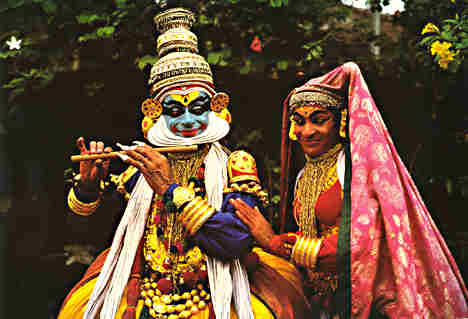
 Katha Kali: As far as historical records show, dance in India has always been associated with spirituality and the pulsating rhythm of cosmic life. Indians have always held dance as sacred and have practiced it as a means of entering into divine consciousness.
Shiva, a principal demigod in Indian religious tradition, is the patron saint of the sacred dance; he is known as "Nataraja," the king of dancers. According to Ananda Cooramaswamy, an eminent Indian scholar, the dance of Shiva is a manifestation of the primal rhythmic energy which has three meanings: first, rhythmic play, the source of all movement within the cosmos; second, the purpose of his dance is to release the countless souls of mankind from the snare of illusion; and finally, the place of dance, Chidambaram, the center of the universe, is within the heart.
According to authorities on Indian sacred dance, and in the words of its countless performers, the dance is profoundly spiritual. The ritual of dance is mentioned in India's earliest literature, the Vedas, and has always accompanied religious ceremonies. The distinguished Indian dancer Enakshi Bhavani, whose book The Dance in India is an authoritative classic on the subject, also calls Indian sacred dance "a science, an art, and an exposition at the same time." Because it demonstrates the deeply philosophical and highly spiritual moods of the Indian people, in India sacred dance is given the foremost position among all the traditional arts.
Bharat Natyam and Sacred Dance
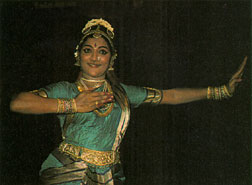
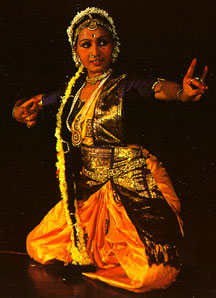 Whereas spontaneity in Indian dance was previously cherished, over the course of time it evolved into a methodical performing art with various schools and strict disciplines. Over 2000 years ago, Bharata Muni wrote the Natya Shastra,or the science of drama which included a comprehensive guide to sacred Indian dance. In this work Bharata Muni says that Brahma, the predominating demigod of this universe, brought the entire science of natya,dance and drama, to the Earth in ancient times.
Bharata Muni, it seems, possessed a mind that delved deeply into the mysteries of that knowledge which comes with yogic meditation and contemplation, and his inner visions of beauty, perfect rhythm, and noble attributes of the symbolic movements provided a formidable prerequisite to his composing his manual. Amazingly enough, most sacred dance in India still follows the outlines and rules laid down in the Natya Shastra.
As in other sacred arts in India such as architecture, some regard the ideal forms—or postures—as symbolic of truth, while others prefer to see them as being in perfect harmony with the cosmic rhythm. Some schools consider that when the sacred dance is properly performed, the divine entities of Godhead and the celestial beings which the performers portray "manifest" themselves onstage; thus the sacred dance becomes one with reality in that it has the ability to uplift the human consciousness from the mundane world to the supernal. Since this requires the disciplined use of the entire body and all of its means of expression, in the Natya Shastra,ten basic postures of the body, thirty-six of the hand, nine of the neck, and thirteen poses of the head are delineated. The various schools of dance have elaborated on these principal postures, each of which has a specific meaning constituting a precise body language capable of telling complex stories to audiences familiar with these conventions. The dancer requires exacting coordination of footwork, bodily movement, hand gestures, placement of arms, and movements of the head, eyes, eyebrows, and neck, synchronized with the finely intricate beats of a drum.
The most striking feature of India's sacred dance is undoubtedly the hand gesture known as the mudra.By a beautiful and complicated code, the hand alone is capable of portraying not only a wide range of emotions, but gods, mortals, animals, natural scenery, action, and so on, and each posture and body movement creates an effect which invokes transcendental emotion. It is a traditional belief that certain currents generated by repeated rhythmic movements of the body create moods and atmosphere that bring powerful results affecting man and nature alike. Thus seasonal dances, festival dances, and ritual dances evolved.
Ultimately, through practice of the standard dance forms sacred dancers could so awaken their spirituality as to dance their way to divine consciousness. In order to attain this elevated state of consciousness, the Indian dancer had to achieve a true unison of the inner self and the physical being and become immersed in the divine.
Before the advent of Buddhism in India, dancers were generally recruited from the upper classes of Indian society. Princesses and women of culture counted dancing as an accomplishment and cultural asset demanding serious study. And study they did, as sacred dance, being a holistic art and science, required well educated and well rounded performers for success. Therefore, prospective dancers from an early age had to learn not only dance, but dramatics, perfume-making, make-up, music, grammar, and the art of conversation, and had to be learned in philosophy and theology.
The ascendancy of Pali Buddhism in India after 500 B.C. interrupted the full and continuous evolution of sacred Indian dance. This form of Buddhism emphasized a more abstract form of spirituality and all of the sacred arts declined during this period, especially since members of the higher echelons of society were forbidden to dance or sing or play on musical instruments. But around the time of Christ, Vedic concepts of philosophy and spirituality in India rebounded to enjoy a strong renaissance, fueled by the immense popularity of the great Vedic classics Ramayanaand Mahabharata.During the first and second centuries A.D. this resurgence gained new heights of achievement for the Vedicarts, including dance, which continued unabated for almost a thousand years.
The Chola dynasty (ninth century to thirteenth century A.D.) gave new impetus to all the sacred arts, especially dance, by rich patronage and devotion. Elaborate temple construction was a special tour de force of the Cholas, and they established schools of sacred dance in their newly-built temple complexes-hence, sculptures of dance in Orissa, Andhra, and all over South India highlighted the unique status of sacred Indian dance during this period.
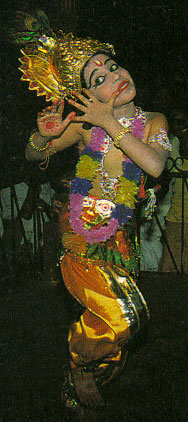
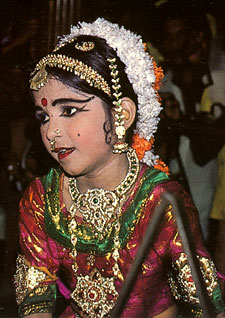 Under the weight of the British occupation of India and the secularizing effects of modernization in the nineteenth century, sacred Indian dance suffered a dramatic decline for the second time; however, the Nobel Prize-winning poet Dr. Rabindranath Tagore and other concerned members of India's high society worked to repopularize sacred Indian dance and make it more accessible to the general public. With the new rise of popularity, dancers were now welcome from almost any sector of society: dancing was no more the elite privilege of the upper classes.
In the twentieth century sacred Indian dance has regained a prominent place on the international stage due to the brilliant work of such dancers as Uday Shankar, whose dancing is applauded on four continents. His performance in the Radha-Krishna Ballet is especially appreciated for bringing to light the grace, power, and subtlety of sacred Indian dance to contemporary audiences.
There are many schools of sacred Indian dance--Bharata Natyam, Kathakali, Kathak, Manipuri, Orissi, Mohini Atam, Krishna Atam, and Bhagavat Mela--all loved by the Indian people. To them the sacred dances represent divine beauty in motion, deliberate steps leading to divine consciousness. Among these schools, two are exceptional for surveying as they are prominent and representative of the rest: Bharata Natyam and Kathakali.
Bharata Natyam is sometimes called "an art for eternity" because its practice today is virtually the same as it was thousands of years ago. It is the most common dance style performed throughout all of India, although the tradition is most popular in the southern states like Tamil Nadu and Kanartaka. Bharata Natyam is the mother art for most of the other sacred dance systems of India and is the main source of inspiration for the allied arts of sculpture, painting, and icon-making. Although Bharata Natyam was originally a child of the temples, it has now become extremely popular on the secular stage as well.
The derivation of the word "Bharata" to describe this system is most intriguing: many experts claim it to be a compilation of the first syllables of the three main elements of Bharata Natyam—bhaas in bhavaor mood, raas in ragaor melody, and taas in talaor rhythmic timing.
In ancient times a group of holy adepts known as the Nattuvanars preserved the art of Bharata Natyam and taught it to others. While the Nattuvanars taught, the female temple dancers known as devidasis or "handmaidens of God" performed. Undergoing rigorous training, many devidasis started developing their skills at the age of five. Some stone inscriptions in Tangore mention that in the eleventh century A.D. nearly 400 devidasis practiced their art of dancing at the famous Brihat-Ishwara temple, while about 100 were attached to the Shiva temple at Kanchipuram. The monarchs of the time made the devidasis an established institution by paying them a salary for their religious duties.
Traditionally, over the last 1000 years women almost exclusively performed Bharata Natyam with one exception-the Bhagavatars, who were members of the brahman or priestly class who found the dance drama the best medium for interpreting the great philosophic teachings of the Bhagavatam scripture, which contains a biographical study of the life of Sri Krishna. The Bhagavatars' performances were known as Bhagavat Melas. Their dramatic action, lyrical composition, choice music and classic dance form were mingled to glorify the spiritual pastimes of Sri Krishna and other incarnations of Godhead in such an entertaining and artistic way as to create an art which truly expounded dance as Bharata Muni had conceived it in his Natya Shastra.
Katha Kali
The trends of modernization have scarcely made any inroads on the naturally isolated state of Kerala in southwest India; therefore, the Kathakali dance style indigenous to this area continues to flourish without any impediments. Because villagers performed this art for other villagers, and village life is so stable in Kerala, this state affords us one of the purest visions of ancient Vedic life and culture.
Kathakali literally means "story play," and is unique in its avant-garde approach toIndian sacred dance form. The performances are based on incidents contained in sacred Sanskrit classics like Mahabharata and Ramayana, on Kerala's own ancient Sanskrit drama Kudiyattam, and on pastimes from Sri Krishna's life that were popularized in Kerala around 1650 A.D.
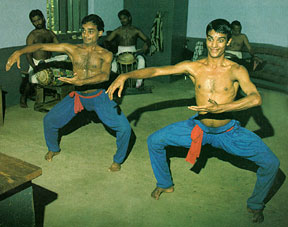 Sacred Indian dance is divided into two categories-vigorous or masculine, and gentle or feminine. Kathakali is most vigorous and is performed by men, yet a similar, gentler form also exists called Kummi in which the performers are mostly women. In either case, the players are spiritual initiates who treat their green room like a shrine and hold all of their paraphernalia to be articles for worship. While following the principles of Natya Shastra,Kathakali has developed its own manual as well, the Hastalakshana Dipika,which contains Kathakali's own special contributions to sacred Indian dance.
Kathakali dancers are highly esteemed in Kerala. In bygone days the leading houses of the land organized their own Kathakali troupes. No expense or trouble was considered too great; the upper classes in Kerala happily patronized Kathakali and continue to do so even to this day.
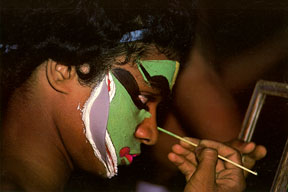 The Kathakali dancer never stands erect. His stance may seem unnatural, but is actually like that of a yogi, whose activity is dictated by a conscious inner force. The dancer's angular movements, tense and virile, create a fabric of rhythms which he weaves with a sustaining strength. Make-up and masks used in Kathakali reveal and enhance the personality of the characters-from head to toe, the Kathakali costumes make for an elaborate presentation. Powerful expression, religious fervor, and pantomime also continue to distinguish Kathakali, with the dancers' faces used more in Kathakali than in any other sacred Indian dance style.
Everything about Kathakali deals with the major archetypes of life. The stage, whether in the courtyard of an ornate temple or in a village meeting place, is about sixteen square feet. The stage represents the world that has come into being in space by the primal act of the creator. In order to evoke the mysteries of existence, Kathakali is never performed during daylight. At sunset the evening's stillness is pierced by vigorous drumming to announce that night's performance, and expectancy is aroused in the people for the open-air, all-night journey into the heart of life.
The only illumination for the performance are two coconut oil-fed lamps supported by tall, shining brass stands. The thicker cluster of wicks faces the stage and represents the sun. The thinner cluster is set towards the audience and symbolizes the moon. These oil-fed lamps have a distinct personality and function in the drama. The lamps both vivify and subdue—an effect that can hardly be improved by the most advanced lighting schemes of the modern stage. The dancing flame of the oil lamp, sometimes leaping and sometimes flickering, pulsates with an almost intelligent energy that seems to be reacting to the rhythmic cadences and moods of the play. The spiritual and mysterious atmosphere of Kathakali is heightened by the lamps, especially in combination with the natural outdoor setting.
The first drumming of a Kathakali show vibrates, "Pralaya, prayala dimurdala," which signals the end of the cosmic deluge and the start of a "New Age." There is no scenery or backgrounds because Kathakali involves the pastimes of Godhead and the demigods who are beyond time and space. Before the main story is told, there is a section of the show called purappad,which means going forward, as in the grand pageant of life on Earth. In the purappad the various phases and moods of this world are depicted.
The drumming, singing, and dancing go on all night and into the early morning. The dance progresses like a serious sacred rite impelled by the force of some mysterious power. Like the waves of an ocean, it surges forward. Sometimes gentle, then rising and swelling, the dance becomes turbulent and overwhelming. Like the avant-garde theater of modern times, when the action in Kathakali is larger than the stage, it spills over, around, and through the audience, as in the performance of the story of Sri Krishna and his poor brahman friend Sudama. First we find Krishna alone with his wife Rukmini in their Dwaraka palace; then suddenly, Krishna becomes restless, looks intently into the distance, and plunges into the densely packed audience. From the rear of the audience we see the thin figure of Krishna's boyhood friend Sudama approaching us in tattered clothes. The performers then return to the center stage.
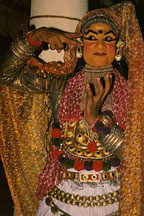 In Sudama's genuine joy at meeting Krishna again after many years of separation, he forgets why he came—to ask Krishna for financial help. Repeatedly, Krishna bows down and then embraces Sudama, offering him all comforts. Overwhelmed by Krishna's kindness, Sudama eventually leaves the palace, satisfied with his reunion with Krishna, but with his pockets empty. Upon returning home, however, he finds that Krishna has built him a palace and stocked it with all the riches necessary for a long and comfortable life.
When the red horizon announces the dawn of a new day, the Kathakali performance comes to an end. The lamps around the stage go out, but the experience, the joy, and the realizations of divinity live on within both the performers and the audience.
Whatever the form of sacred dance in India, the ultimate goal is to bring its participants to higher and higher levels of self-realization. To the uninformed observer it may appear that the dance is meant for a good evening's entertainment, but entertainment is an experience of the mind and body, whereas the real experience of sacred dance is transcendental to all the material senses. Proper understanding of the inner meaning of sacred dance enables all of its participants to be drawn closer to the "stage" of divine consciousness through the medium of sound, movement, and emotion.