
Worshipping God - Salagrama-sila
Sri Chaitanya as Salagrama-sila
 It is our nature to worship. From prehistoric times to the present, human society has been engaged in some form of veneration. Secularizing our ritual from the religious to the ridiculous does not change the fact that we are about worship. India is no exception to this reality, where worship has for the most part remained God-centered for thousands of years. The two most popular forms of worship among the followers of the Vedic dharma are devotion to Visnu and Siva. In both the Visnu and Siva bhakti traditions we find the worship of Salagrama-sila.
Salagrama-silas are sacred black stones that come from the Gandaki River valley of the Himalayas. Sila means stone. The qualities and characteristics of the Salagrama-silas are not found on stones anywhere on earth except in the Gandaki region. There, in that remote area of the world nestled between the Dhaulagiri and Annapurna mountain ranges, the Gandaki River flows through the village of Salagrama and the asrama of Pulaha. In ancient times, the mountain range surrounding Pulaha was called Salagiris due to the vast forests of Sala trees. From this came the name Salagrama (village of Sala trees) and Salagrama-sila (stones found only in the region of Salagrama).
These small black stones are more than meets the naked eye. All followers of Vedic dharma, with Gaudiya Vaisnavas no exception, consider salagrama to be a direct manifestation of Visnu himself.
According to contemporary geologists, the Salagrama-silas are fossils of a prehistoric insect. This insect is mentioned in the Bhavisya Purana. Therein, Tulasi, the sacred plant so dear to Visnu, cursed Visnu to become a stone during one act of their eternal lila. Visnu said, "To fulfill your curse, I will become a stone (Salagrama-sila ) and will always live on the banks of the Gandaki River. The millions of Vajrakita worms that live at that place will adorn those stones with the signs of my cakra by carving them with their sharp teeth."
 The geologists' suggestion is thus not entirely unacceptable. It is supported to some extent by sacred literature. However, for the tradition, the Vajrakita is the secondary cause, whereas Visnu himself is the principal cause of his manifestation as Salagrama-sila. The cursing of Visnu is also considered a secondary cause. In Gaudiya Vaisnava theology, Visnu in the form of Krsna is considered to be the cause of all causes, sarva karana karanam. The main cause of God's appearance in this world is his own desire. Corresponding to Visnu's desire is the desire of his devotee, the Vaisnava. In regards to the Salagrama-sila, Visnu desired to appear in this world in a form which could be easily worshipped and maintained by his devotees. Thus the drama of accepting the curse to become a stone was enacted with the help of his devotees. An elaboration on just how Visnu was cursed to become a stone is narrated in the Brahma-vivarta Purana as follows.
There once appeared on earth as the daughter of King Dharmadhvaja and his queen Madhavi a beautiful princess who was a plenary expansion of the hladhini-sakti, or internal pleasure potency of Godhead. When the child was born she was decorated with all the signs of good fortune. She matured to be exquisitely beautiful and never aged beyond sixteen years. Her beauty was captivating and pleasing to the heart of everyone. She was the manifestation of all divine qualities, and thus she was called Tulasi (matchless).
When Visnu wants to perform his lilas on earth, he does so only in the association of his personal potencies appearing as his eternal associates. The potency which arranges for Visnu's pleasure is called hladhini. In the eternal Goloka, where the Supreme resides eternally as Sri Krsna, that hladhini potency is eternally manifest as Srimati Radharani, the original goddess of fortune. When Krsna descends to this mundane world as a Visnu avatara to perform pastimes, similarly his hladhini potency manifests along with him. The expansions that accompany the Visnu avataras are called Laksmis. The princess who appeared as the daughter of King Dharmadhvaja and Queen Madhavi was an expansion of Laksmi, the goddess of fortune.
By the will of providence, Tulasi was wedded to Sankhacuda, a powerful demon. Sankhacuda had received a boon from Lord Brahma to get Tulasi as his wife and remain undefeated in battle as long as she remained chaste to him. Taking advantage of Brahma's boon, Sankhacuda began to terrorize all the demigods. Being severely afflicted by his attacks, the demigods approached Siva for protection. Siva went himself to fight with Sankhacuda, but because of the chastity of Tulasi, Siva was unable to kill him.
When all became hopeless for the demigods, Visnu devised a plan to spoil the chastity of Tulasi. While Siva and Sankhacuda were engaged in ferocious combat, Visnu went there in the guise of a brahmana to beg charity from Sankhacuda. Standing before Sankhacuda, the brahmana requested, "My dear Sankhacuda, famous throughout the three worlds as the giver of whatever one desires, please give me your kavaca (armor) in charity."
Knowing that it was the chastity of his wife, Tulasi, that protected him, Sankhacuda unhesitatingly gave the brahmana his armor in charity and resumed his fight with Siva. Dressed in Sankhacuda's armor, Visnu went to the palace where Tulasi was waiting. Thinking that her husband had returned from battle to regain his strength, Tulasi welcomed him to the bed chamber for rest. Thus the night passed and the chastity of Tulasi was broken by the tricks of Visnu, and at that moment Sankhacuda was slain by Siva in the midst of battle.
When Tulasi understood that the Sankhacuda that slept the night in her bed chamber was actually Visnu and not her husband and that Sankhacuda had been killed by Siva, Tulasi cursed Visnu. "By deceiving me, you have broken my chastity and killed my husband. Only one whose heart is like stone could do such a thing. Thus I curse you to remain on earth as a stone!"
Accepting the curse of Tulasi, Visnu then replied, "For many years you underwent very difficult penances to achieve me as your husband. At the same time, Sankhacuda also performed penances to get you as his wife. As a result of a boon from Lord Brahma, the desire of Sankhacuda was fulfilled. Now that Sankhacuda has left this mortal world and gone to the spiritual world, your desire to have me as your husband will be fulfilled. It is my benediction that your present body will be transformed into the Gandaki River and from your beautiful hair will grow millions of small trees that will be known as Tulasi. These trees will be held sacred by all my devotees, the Vaisnavas. To fulfill your curse, I will become many stones (Salagrama-sila ) and will always live on the banks of the Gandaki River."
Thus Tulasi appeared as the Gandaki River and as the sacred plant Tulasi, and Visnu began to dwell in the world as Salagrama-sila in the waters and on the banks of the Gandaki. It is also mentioned in the Brahma-vaivarta Purana that Sankhacuda was an eternal associate of Krsna named Sudama who manifested in this world as a demon to assist in these pastimes.
From the time these eternal events took place until the present, the devotees of both Visnu and Siva pilgrimage to the Gandaki River in the Himalayas and collect the Salagrama-sila and worship them with the leaves of the Tulasi plant. There is a reference to offering Tulasi leaves to Krsna in the Bhagavad-gita (9.26):
patram puspam phalam toyam yo me bhaktya prayacchati
tad aham bhakty-upahrtamasnami prayatatmanah
If my devotee offers me with devotion, a leaf, a flower, a fruit, or water, I will accept it.
According to the acaryas, great spiritual masters, the patram (leaf) mentioned in this verse particularly refers to the Tulasi leaf. It is also mentioned in the Garuda Purana and the Brhan-naradiya Purana that worship without Tulasi leaves is never accepted by Visnu. "Without Tulasi, anything done in the way of worship, bathing, and offering of food and drink to Visnu/Krsna cannot be considered real worship, bathing, or offering. Visnu does not accept any worship, or eat or drink anything that is without Tulasi."
The ritual of Salagrama-sila worship was so well-accepted in India that up until the advent of secular society in 1947 the Salagrama-sila was worshipped in practically every household. At the present time, Salagrama-sila is still worshipped in major temples throughout the country and in the homes of very pious persons.
There are many references found in the Puranas regarding the special sanctity of Salagrama-sila. In the Skanda Purana it is said:
mlecchadese sucav vapi cakranko yatra tisthati
yajanani tatha trini mama ksetram vasundhare
tanmadhye mriyate yastu pujakah susamahitah
sarva vadhavinirmukto punah so api na jayate
"A Salagrama-sila, when duly worshipped at any place inhabited by any class of people, is able to purify an area with a radius of 24 miles. That area should be considered Visnu-loka, nondifferent from the abode of Visnu. If someone believing in the sanctity of Salagrama-sila, as per the verdict of the sastra, breathes their last within that 24 mile radius, he is sure to attain mukti, salvation from material bondage."
We also find mention in the Puranas of various kinds of Salagrama-sila, differentiated according to their markings and variation in color. Some of the names and qualities of Salagrama-silas are as follows: The Vasudeva-sila is white in color and is very attractive looking. It has two equal-sized cakras, or discs, on the front, but slightly off-center. The Sankarsana-sila is red-colored, with two cakras combined in one section and a well-formed front. It is very beautiful to see. The Pradyumna-sila is yellow with small cakras and a very large mouth with many small holes within it. The Aniruddha-sila steals the mind with his blue color and beautiful round shape. He has three lines in front of his mouth and a lotus mark on his back. The Narayana-sila is black with a cakra on his raised navel. The Nrsimha-sila is black with a large mouth and two cakras within, one on top and one on the bottom.
With the help of the Puranas, it is possible for the worshipper to identify several hundred different kinds of Salagrama-silas which correspond to the many incarnations and manifestations of Visnu/Krsna. The worship of a particular Salagrama-sila will bring a particular desired result. If one worships the Nrsimha-sila, one gets liberation and attains victory in battle. One who worships the Varaha-sila gets material enjoyment and liberation after death, and the worshipper of the Laksmi-Narayana-sila will attain kingship in heaven. It is also said in the Puranas that one can worship any Salagrama-sila one desires and simply meditate on the form of Visnu/Krsna most dear to one's heart.
In the Vedic culture the first goal of life is to embrace dharma, religiousity. The next three stages of life are artha (economic development), kama (material enjoyment), and moksa (liberation). Worship of Salagrama-sila is recommended in the codes of dharma and almost all the worshippers of Salagrama-sila seek either economic development or material enjoyment. These worshippers are known as karma-kandis, those who seek a material benefit from their worship.
Visnu is the maintainer of the universe and thus he is inclined to bless his worshippers with the fulfillment of their desires. However, one should remember that fulfillment of material desires is ultimately unfulfilling because material desires pertain to the satisfaction of the body, mind, and senses which are destined to destruction at the time of death. Therefore, one who approaches Visnu for material benefit, although pious, does not know about the ultimate benediction.
In this regard, there once arose a difficult situation when Srila Bhaktisiddhanta Sarasvati Thakura, the renowned preceptor of the Gaudiya Matha, was conducting his preaching activities in the early part of this century with the help of diorama exhibitions. Sarasvati Thakura wanted to emphasize that the worship of Salagrama-sila for some material benefit is almost irreligious from the highest point of view. The essence of dharma is hari-tosanam, the satisfaction of Hari, Krsna. To the extent that one pleases God, religion is meaningful and we ourselves will be satisfied. To demonstrate this point, Sarasvati Thakura ordered the construction of a diorama exhibiting a man in generic Hindu brahmana dress sitting before an altar arranged for Salagrama-sila worship. The brahmana was holding a Salagrama-sila in his hand, using the stone as a nutcracker. Sarasvati Thakura's point was that Visnu feels like a nutcracker in the hands of one who simply worships him for filling the belly and getting other such temporary benefits. This nutcracker diorama appeared in Calcutta at a theistic exhibition sponsored by Gaudiya Matha.
A certain group of aristocratic brahmana gentlemen of Calcutta took exception to the diorama, and even went so far as to file a civil court case against the Gaudiya Matha in an attempt to close down the exhibition. Sarasvati Thakura had to send his preachers before the magistrate to answer the complaint. There, the preachers of Sarasvati Thakura prevailed by demonstrating the validity of the diorama.
The only valid objection that the opposing party raised was that this anomaly was not relative to only Hindu brahmanas, even a Vaisnava might be guilty of worshipping Salagrama-sila for material gains. Sarasvati Thakura agreed and suggested that the Vaisnava markings of tilaka be painted on the forehead of the generic brahmana. At this the brahmana gentlemen were defeated, and they realized that Sarasvati Thakura had not intended any malice towards the brahmanas as a community, but that he indeed was a pure theist who drew his concepts and conclusions from the absolute consideration and not in favor of any particular caste or creed.
Those who approach Visnu for moksa, liberation from material bondage, are said to be most intelligent. For literally millions of lifetimes, the soul is wandering in material existence suffering the fourfold miseries of birth, old age, disease, and death. When one gets liberation from the cycle of birth and death, one is said to have achieved the fourth goal of life. Worship with the goal of liberation is the approach in which we find the followers of Sankaracarya, Ramanujacarya, Madvacarya, and others -- Smartas, Sivaites, etc. All these worshippers adore the Salagrama-sila for liberation.
What to speak of worshipping the Salagrama-sila for material benefit, the pure Gaudiya Vaisnavas even reject worshipping the Salagrama-sila for liberation. Gaudiya Vaisnavas have as their ultimate aim the fifth goal of life-a goal superior to even liberation from material bondage. That fifth goal of life is prema, or divine love of God following in the wake of the eternal associates of Vraja Krsna. The preceptor of this fifth goal of life is Sri Chaitanya.
Sri Chaitanya taught his followers that worship which is free from the desire for material benefits or liberation brings one to the platform of love of Krsna. In that stage of unmotivated, pure love, one worships the Salagrama-sila for the sake of pleasing the senses of Krsna, hrsikena hrsikesa-sevanam bhaktir ucyate: "All worship is meant to please the master of the senses, Krsna."
Devotion is both the means and the end of Gaudiya Vaisnavism. Visnu, as the maintainer and benefactor of his devotees, awards material benefits and even liberation to his worshipper, but only Krsna is completely conquered by love. With eyes tinged with the salve of love, Gaudiya Vaisnavas see Radha-Krsna everywhere, even within the Salagrama-sila. A story from Gaudiya Vaisnava history illustrates the power of love in relation to the worship of Salagrama.
When Sri Chaitanya was touring South India, he arrived at the holy city of Srirangam just at the beginning of the four months of the monsoon season. There he established a friendship with the head priest of the Ranganatha temple, Sri Venkata Bhatta, and remained in his house for four months continuously. During that time, Gopala Bhatta, the son of Venkata Bhatta, became very attached to Sri Chaitanya and with firm determination, the young boy made up his mind to accept Sri Chaitanya as his guide and spiritual master.
At the age of thirty, after his mother and father had passed away, Gopala Bhatta traveled north and came to reside in Vrndavana. There he had the company of many of Sri Chaitanya's senior associates and disciples like Rupa and Sanatana Goswamis. After some time, Sri Chaitanya appeared in a dream to Gopala Bhatta and instructed him to make a pilgrimage to the Gandaki River to collect Salagrama-sila. Sri Chaitanya also informed Gopala Bhatta that by worshipping Salagrama-sila he would soon get his darsana (divine vision).
Gopala Bhatta set out on foot toward the Gandaki River. After a long and arduous journey, Gopala Bhatta reached the Gandaki at Salagrama and happily took his bath there. Having placed his waterpot in the river, he saw that several Salagrama-silas had entered the vessel. Removing the Salagrama-silas from the pot, he again placed them in the water and again he saw that several Salagrama-silas had entered his pot. Again he removed the Salagrama-silas from his pot and placed them in the water and again the same thing happened. This time Gopala Bhatta saw that twelve Salagrama-silas had entered his waterpot. Considering this to be the mercy of Sri Chaitanya, he decided to bring those twelve Salagrama-silas back to Vrndavana.
In Vrndavana, Gopala Bhatta began the worship of the twelve Salagrama-silas with great devotion. Gopala Bhatta was always thinking of Sri Chaitanya's words spoken in his dream. In this way, his worship of Salagrama-sila continued and his desire to have the promised darsana of Sri Chaitanya became very, very intense.
One day a wealthy gentleman approached Gopala Bhatta to offer a selection of dresses and costly silver and gold ornaments to use in the worship of the Salagrama-silas. Gopala Bhatta requested that the man present the dresses and ornaments to a temple in Vrndavana where the Deity form of Krsna was being worshipped. At this instance, Gopala Bhatta began to remember the promise of Sri Chaitanya and feeling great separation he yearned for the Lord's darsana.
It happened to be the appearance day of Sri Nrsimhadeva who manifest himself before his devoted servant, Prahlada Maharaja. Thus Gopala Bhatta began to pray, "O Lord, you are very merciful and fulfill the desires of your devotees. I desire to serve your ecstatic form. Therefore, please reveal yourself. What can I do? I am hopeless and I cannot sustain my life any longer if you do not bless this humble beggar."
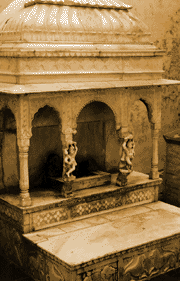
Radha-ramana appeared
That night Gopala Bhatta slept only a short while and when he awoke in the morning he found that one of the twelve Salagrama-silas, the Damodara-sila, which he kept in a simple straw basket had manifest as Sri Krsna. From the Damodara-sila, which was approximately two inches wide, had manifested the full-fledged form of Krsna, measuring 11 1/8 inches in height. The form of Krsna had manifest in the classic tribhanga-svarupa, threefold bending form with his hands poised for playing a flute. This form is described in the Brahma-samhita:
alola-candraka-lasad-vanamalya-vamsi
ratnangadam pranaya-keli-kala-vilasam
syamam tribhanga lalitam niyata-prakasam
govindam adi-purusam tam aham bhajami
I worship Govinda/Krsna around whose neck is a garland of forest flowers swinging to and fro, and whose head is adorned with a peacock feather. His hands carry the flute and his arms are bedecked with jeweled bracelets. He eternally enjoys in pastimes of love and his charming threefold bending figure of a blackish hue is eternally manifest. (Bs. 5.31)
Gopala Bhatta called for his senior mentors, Rupa and Sanatana Goswamis, and other highly elevated souls to see what had happened. It was determined by those great saintly persons that Sri Chaitanya had indeed fulfilled his promise to Gopala Bhatta by giving him his svarupa-darsana. Sri Chaitanya is none other than the combined forms of Radha and Krsna:
radha-krsna-pranaya-vikrtir hladini saktir asmad
ekatmanav api bhuvi pura deha-bhedam gatau tau
caitanyakhyam prakatam adhuna tad-dvayam caikyam aptam
radha-bhava-dyuti-suvalitam naumi krsna-svarupam
The loving affairs of Sri Sri Radha-Krsna are transcendental manifestations of the Lord's internal pleasure-giving potency. Although Radha and Krsna are one in their identity, they have separated themselves eternally. Now these two transcendental identities have again united in the form of Sri Chaitanya. I bow down to him, who has manifested himself with the sentiment and complexion of Srimati Radharani although he is Krsna himself. (Cc. Adi 1.4)
Thus the form of Krsna which had self-manifested from the Damodara-sila was named Radha-ramana, being the combined forms of Radha and Ramana/Krsna (Ramana means one who gives great pleasure to Srimati Radharani). The highest revealed form of Godhead is that of the combined forms of Krsna and his hladhini-sakti, Srimati Radharani, and this divine reality was manifest from the Salagrama-sila. This is the ultimate Salagrama-sila darsana.