
Introduction
The aryan invasion theory has been one of the most controversial historical topics for well over a century. However, it should be pointed out that it remains just that – a theory. To date no hard evidence has proven the aryan invasion theory to be fact. In this essay we will explain the roots of this hypothesis and how, due to recent emergence of new evidence over the last couple of decades, the validity of the aryan invasion theory has been seriously challenged.
It is indeed ironic that the origin of this theory does not lie in Indian records, but in 19th Century politics and German nationalism. No where in the Vedas, Puranas or Itihasas is there any mention of a Migration or Invasion of any kind. In 1841 M.S. Elphinstone, the first governor of the Bombay Presidency, wrote in his book History of India:
 'It is opposed to their (Hindus) foreign origin, that neither in the Code (of Manu) nor, I believe, in the Vedas, nor in any book that is certainly older than the code, is there any allusion to a prior residence or to a knowledge of more than the name of any country out of India. Even mythology goes no further than the Himalayan chain, in which is fixed the habitation of the gods... .To say that it spread from a central point is an unwarranted assumption, and even to analogy; for, emigration and civilization have not spread in a circle, but from east to west. Where, also, could the central point be, from which a language could spread over India, Greece, and Italy and yet leave Chaldea, Syria and Arabia untouched? There is no reason whatever for thinking that the Hindus ever inhabited any country but their present one, and as little for denying that they may have done so before the earliest trace of their records or tradition.’
The Birth of a Misconception
Interest in the field of Indology during the 19th Century was of mixed motivations. Many scholars such as August Wilhelm von Schlegal, Hern Wilhelm von Humboldt, and Arthur Schopenhauer lauded praise upon the Vedic literatures and their profound wisdom, others were less than impressed. To accept that there was an advanced civilization outside the boundaries of Europe, at a time before the Patriarchs Abraham and Moses had made their covenant with the Almighty was impossible to conceive of for most European scholars, who harbored a strong Christian tendency. Most scholars of this period were neither archeologists nor historians in the strict sense of the word. Rather, they were missionaries paid by their governments to establish western cultural and racial superiority over the subjugated Indian citizens, through their study of the indigenous religious texts. Consequently, for racial, political and religious reasons, early European indologists created a myth that still survives to this day.
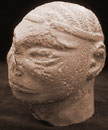 It was established by linguists that Sanskrit, Iranian and European languages all belonged to the same family, categorizing them as ‘Indo-European’ languages. It was assumed that all these people originated from one homeland where they spoke a common language (which they called ‘Proto-Indo-European’ or PIE) which later developed into Sanskrit, Latin, Greek etc. They then needed to ascertain where this homeland was. By pure speculation, it was proposed that this homeland was either southeast Europe or Central Asia.
Harappa and Mohenjo-daro
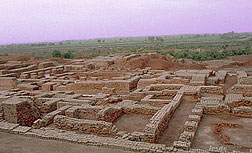
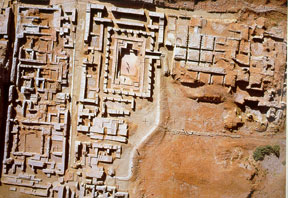
The discovery of ruins in the Indus Valley (Harappa and Mohenjo-daro) was considered by indologists like Wheeler as proof of their conjectures – that a nomadic tribe from foreign lands had plundered India. It was pronounced that the ruins dated back to a time before the Aryan Invasion, although this was actually never verified. By assigning a period of 200 years to each of the several layers of the pre-Buddhist Vedic literature, indologists arrived at a time frame of somewhere between 1500 and 1000BC for the Invasion of the Aryans. Using Biblical chronology as their sheet anchor, nineteenth century indologists placed the creation of the world at 4000BC1 and Noah’s flood at 2500BC. They thus postulated that the Aryan Invasion could not have taken place any time before 1500BC.
Archeologists excavating the sites at Harappa and Mohenjo-daro found human skeletal remains; this seemed to them to be undeniable evidence that a large-scale massacre had taken place in these cities by the invading Aryan hordes. Prof. G. F. Dales (Former head of department of South-Asian Archaeology and Anthropology, Berkeley University, USA) in his ‘The Mythical Massacre at Mohenjo-daro’, states the following about this evidence:
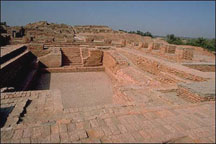
 ‘What of these skeletal remains that have taken on such undeserved importance? Nine years of extensive excavations at Mohenjo-daro (1922-31) - a city of three miles in circuit - yielded the total of some 37 skeletons, or parts thereof, that can be attributed with some certainty to the period of the Indus civilizations. Some of these were found in contorted positions and groupings that suggest anything but orderly burials. Many are either disarticulated or incomplete. They were all found in the area of the Lower Town - probably the residential district. Not a single body was found within the area of the fortified citadel where one could reasonably expect the final defense of this thriving capital city to have been made…Where are the burned fortresses, the arrow heads, weapons, pieces of armor, the smashed chariots and bodies of the invaders and defenders? Despite the extensive excavations at the largest Harappan sites, there is not a single bit of evidence that can be brought forth as unconditional proof of an armed conquest and the destruction on the supposed scale of the Aryan Invasion.’
Evidence from the Vedas
It was therefore concluded that light-skinned nomads from Central Asia who wiped out the indigenous culture and enslaved or butchered the people, imposing their alien culture upon them had invaded the Indian subcontinent. They then wrote down their exploits in the form of the Rg Veda. This hypothesis was apparently based upon references in the Vedas that point to a conflict between the light-skinned Aryans and the dark-skinned Dasyus.2 This theory was strengthened by the archeological discoveries in the Indus Valley of the charred skeletal remains that we have mentioned above. Thus the Vedas became nothing more than a series of poetic tales about the skirmishes between two barbaric tribes.
However, there are other references in the Rg Veda3 that point to India being a land of mixed races. The Rg Veda also states that "We pray to Indra to give glory by which the Dasyus will become Aryans."4 Such a statement confirms that to be an Aryan was not a matter of birth.
An inattentive skimming through the Vedas has resulted in a gross misinterpretation of social and racial struggles amongst the ancient Indians. North Aryans were pitted against the Southern Dravidians, high-castes against low-castes, civilized orthodox Indians against barbaric heterodox tribals. The hypothesis that of racial hatred between the Aryans and the dark-skinned Dasyus has no sastric foundation, yet some ‘scholars’ have misinterpreted texts to try to prove that there was racial hatred amongst the Aryans and Dravidians (such as the Rg Veda story of Indra slaying the demon Vrta5 ).
Based on literary analysis, many scholars including B.G. Tilak, Dayananda Saraswati and Aurobindo dismissed any idea of an Aryan Invasion. For example, if the Aryans were foreign invaders, why is it that they don’t name places outside of India as their religious sites? Why do the Vedas only glorify holy placeswithin India?
What is an ‘Aryan’?

The Sanskrit word ‘Aryan’ refers to one who is righteous and noble. It is also used in the context of addressing a gentleman (Arya-putra, Aryakanya etc).6 Nowhere in the Vedic literature is the word used to denote race or language. This was a concoction by Max Mueller who, in 1853, introduced the word ‘Arya’ into the English language as referring a particular race and language. He did this in order to give credibility to his Aryan race theory (see Part 2). However in 1888, when challenged by other eminent scholars and historians, Mueller could see that his reputation was in jeopardy and made the following statement, thus refuting his own theory -
"I have declared again and again that if I say Aryas, I mean neither blood nor bones, nor hair, nor skull; I mean simply those who speak an Aryan language...to me an ethnologist who speaks of Aryan race, Aryan blood, Aryan eyes and hair, is as great a sinner as a linguist who speaks of a dolichocephalic dictionary or a brachycephalic grammar."
(Max Mueller, Biographies of Words and the Home of the Aryas, 1888, pg 120)
But the die had already been cast! Political and Nationalist groups in Germany and France exploited this racial phenomenon to propagate the supremacy of an assumed Aryan race of white people. Later, Adolf Hitler used this ideology to the extreme for his political hegemony and his barbaric crusade to terrorize Jews, Slavs and other racial minorities, culminating in the holocaust of millions of innocent people.
 According to Mueller’s etymological explanation of ‘Aryan’, the word is derived from ‘ar’ (to plough, to cultivate). Therefore Arya means ‘a cultivator, or farmer’. This is opposed to the idea that the Aryans were wandering nomads. V.S. Apte's Sanskrit-English Dictionary relates the word Arya to the root ‘r-’ to which the prefix ‘a’ has been added in order to give a negating meaning. Therefore the meaning of Arya is given as ‘excellent, best’, followed by ‘respectable’ and as a noun, ‘master, lord, worthy, honorable, excellent,’ ‘upholder of Arya values, and further: teacher, employer, master, father-in-law, friend.’
No Nomads
 Kenneth Kennedy of Cornell University has recently proven that there was no significant influx of people into India during 4500 to 800BC. Furthermore it is impossible for sites stretching over one thousand miles to have all become simultaneously abandoned due to the Invasion of Nomadic Tribes.
There is no solid evidence that the Aryans belonged to a nomadic tribe. In fact, to suggest that a nomadic horde of barbarians wrote books of such profound wisdom as the Vedas and Upanisads is nothing more than an absurdity and defies imagination.
Although in the Rg Veda Indra is described as the ‘Destroyer of Cities,’ the same text mentions that the Aryan people themselves were urban dwellers with hundreds of cities of their own. They are mentioned as a complex metropolitan society with numerous professions and as a seafaring race. This begs the question, if the Aryans had indeed invaded the city of Harrapa, why did they not inhabit it after? Archeological evidence shows that the city was left deserted after the ‘Invasion’.
Colin Renfrew, Prof. of Archeology at Cambridge, writes in his book Archeology and Language: The Puzzle of Indo-European Origins’ -
‘It is certainly true that the gods invoked do aid the Aryas by over-throwing forts, but this does not in itself establish that the Aryas had no forts themselves. Nor does the fleetness in battle, provided by horses (who were clearly used primarily for pulling chariots), in itself suggest that the writers of these hymns were nomads. Indeed the chariot is not a vehicle especially associated with nomads’
Horses and Chariots
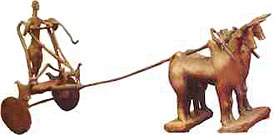 The Invasion Theory was linked to references of horses in the Vedas, assuming that the Aryans brought horses and chariots with them, giving military superiority that made it possible for them to conquer the indigenous inhabitants of India. Indologists tried to credit this theory by claiming that the domestication of the horse took place just before 1500BC. Their proof for this was that there were no traces of horses and chariots found in the Indus Valley. The Vedic literature nowhere mentions riding in battle and the word ‘asva’ for horse was often used figuratively for speed. Recent excavations by Dr.S.R. Rao have discovered both the remains of a horse from both the Late Harrapan Period and the Early Harrapan Period (dated before the supposed Invasion by the Aryans), and a clay model of a horse in Mohenjo-daro. Since Dr. Rao’s discoveries other archeologists have uncovered numerous horse bones of both domesticated and combat types. New discoveries in the Ukraine also proves that horse riding was prevalent as early as 4000BC – thus debunking the misconception that the Aryan nomads came riding into history after 2000BC.
Another important point in this regard is that nomadic tribes do not use chariots. They are used in areas of flat land such as the Gangetic plains of Northern India. An Invasion of India from Central Asia would require crossing mountains and deserts – a chariot would be useless for such an exercise. Much later, further excavations in the Indus Valley (and pre-Indus civilizations) revealed horses and evidence of the wheel on the form of a seal showing a spoked wheel (as used on chariots).
An Iron Culture
Similarly, it was claimed that another reason why the Invading Aryans gained the upper hand was because their weapons were made of iron. This was based upon the word ‘ayas’ found in the Vedas, which was translated as iron. Another reason was that iron was not found in the Indus Valley region.
 However, in other Indo-European languages, ayas refers to bronze, copper or ore. It is dubious to say that ayas only referred to iron, especially when the Rg Veda does not mention other metals apart from gold, which is mentioned more frequently than ayas. Furthermore, the Yajur and Atharva Vedas refer to different colors of ayas. This seems to show that he word was a generic term for all types of metal. It is also mentioned in the Vedas that the dasyus (enemies of the Aryans) also used ayas to build their cities. Thus there is no hard evidence to prove that the ‘Aryans invaders’ were an iron-based culture and their enemies were not.
Yajna-vedhis
Throughout the Vedas, there is mention of fire-sacrifices (yajnas) and the elaborate construction of vedhis (fire altars). Fire-sacrifices were probably the most important aspect of worshiping the Supreme for the Aryan people. However, the remains of yajna-vedhis (fire altars) were uncovered in Harrapa by B.B. Lal of the Archeological Survey of India, in his excavations at the third millenium site of Kalibangan.
The geometry of these yajna-vedhis is explained in the Vedic texts such as the Satpatha-brahmana. The University of California at Berkley has compared this geometry to the early geometry of Ancient Greece and Mesopotamia and established that the geometry found in the Vedic scriptures should be dated before 1700BC. Such evidence proves that the Harrapans were part of the Vedic fold.
Objections in the Realm of Linguistics and Literature
 There are various objections to the conclusions reached by the indologists concerning linguistics. Firstly they have never given a plausible excuse to explain how a Nomadic Invasion could have overwhelmed the original languages in one of the most densely populated regions of the ancient world.
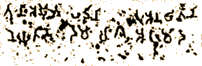 Secondly, there are more linguistic changes in Vedic Sanskrit than there are in classical Sanskrit since the time of Panini (aprox.500 BC). So although they have assigned an arbitrary figure of 200 year periods to each of the four Vedas, each of these periods could have existed for any number of centuries and the 200 year figure is totally subjective and probably too short a figure.
Another important point is that none of the Vedic literatures refer to any Invasion from outside or an original homeland from which the Aryans came from. They only focus upon the region of the Seven Rivers (sapta-sindhu). The Puranas refer to migrations of people out of India, which explains the discoveries of treaties between kings with Aryan names in the Middle East, and references to Vedic gods in West Asian texts in the second millenium BC. However, the indologists try to explain these as traces of the migratory path of the Aryans into India.
North-South Divide
Indologists have concluded that the original inhabitants of the Indus Valley civilization were of Dravidian descent. This poses another interesting question. If the Aryans had invaded and forced the Dravidians down to the South, why is there no Aryan/Dravidian divide in the respective religious literatures and historical traditions? Prior to the British, the North and South lived in peace and there was a continuous cultural exchange between the two. Sanskrit was the common language between the two regions for centuries. Great acaryas such as Sankara, Ramanuja, Madhva, Vallabha, and Nimbarka were all from South, yet they are all respected in North India. Prior to them, there were great sages from the South such as Bodhayana and Apastamba. Agastya Rsi is placed in high regard in South India as it is said that he brought the Tamil language from Mount Kailasa to the South.7 Yet he is from the North! Are we to understand that the South was uninhabited before the Aryan Invasion? If not, who were the original inhabitants of South India, who accepted these newcomers from the North without any struggle or hostility?
Saivism
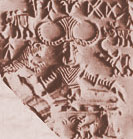
The advocates of the Invasion theory argue that the inhabitants of Indus valley were Saivites (Siva worshippers) and since Saivism is more prevalent among the South Indians, the inhabitants of the Indus valley region must have been Dravidians. Siva worship, however, is not alien to Vedic culture, and is certainly not confined to South India. The words Siva and Sambhu are not Dravidian in origin as some indologists would have us believe (derived from the Tamil words ‘civa’ - to redden, to become angry, and ‘cembu’ - copper, the red metal). Both words have Sanskrit roots – ‘si’ meaning auspicious, gracious, benevolent, helpful, kind, and ‘sam’ meaning being or existing for happiness or welfare, granting or causing happiness, benevolent, helpful, kind. These words are used in this sense only, right from their very first occurrence. 8 Moreover, some of the most important holy places for Saivites are located in North India: the traditional holy residence of Lord Siva is Mount Kailasa situated in the far north. Varanasi is the most revered and auspicious seat of Saivism. There are verses in the Rg Veda mentioning Siva and Rudra and consider him to be an important deity. Indra himself is called Siva several times in Rg Veda (2:20:3, 6:45:17, 8:93:3).
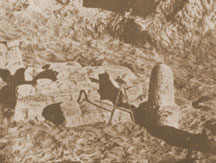 So Siva is not a Dravidian divinity only, and by no means is he a non-Vedic divinity. Indologists have also presented terra-cotta lumps found in the fire-alters in Harappa and taken them to be Siva-lingas, implying that Saivism was prevalent among the Indus valley people. But these terra-cotta lumps have been proved to be the measures for weighing commodities by shopkeepers and merchants. Their weights have been found in perfect integral ratios, in the manner like 1 gm, 2 gms, 5 gms, 10 gms etc. They were not used as the Siva-lingas for worship, but as the weight measurements.
The Discovery of the Sarasvati River
Whereas the famous River Ganga is mentioned only once in the Rg Veda, the River Sarasvati is mentioned at least sixty times. Sarasvati is now a dry river, but it once flowed all the way from the Himalayas to the ocean across the desert of Rajasthan. Research by Dr. Wakankar has verified that the River Sarasvati changed course at least four times before going completely dry around 1900BC. 9 The latest satellite data combined with field archaeological studies have shown that the Rg Vedic Sarasvati had stopped being a perennial river long before 3000 BC.
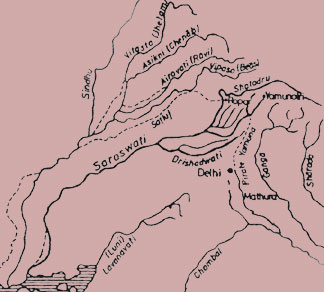 As Paul-Henri Francfort of CNRS, Paris recently observed –
"...We now know, thanks to the field work of the Indo-French expedition that when the proto-historic people settled in this area, no large river had flowed there for a long time."
The proto-historic people he refers to are the early Harappans of 3000 BC. But satellite photos show that a great prehistoric river that was over 7 kilometers wide did indeed flow through the area at one time. This was the Sarasvati described in the Rg Veda. Numerous archaeological sites have also been located along the course of this great prehistoric river thereby confirming Vedic accounts. The great Sarasvati that flowed "from the mountain to the sea" is now seen to belong to a date long anterior to 3000 BC. This means that the Rg Veda describes the geography of North India long before 3000 BC. All this shows that the Rg Veda must have been in existence no later than 3500 BC. 10
With so many eulogies composed to the River Sarasvati, we can gather that it must have been well known to the Aryans, who therefore could not have been foreign invaders. This also indicates that the Vedas are much older than Mahabharata, which mentions the Sarasvati as a dying river.
Discoveries of New Sites
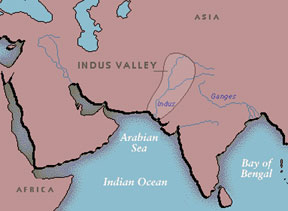
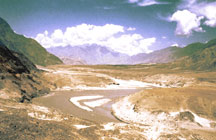 Since the initial discoveries of Mohenjo-daro and Harappa on the Ravi and Sindhu rivers in 1922, over 2500 other settlements have been found stretching from Baluchistan to the Ganga and beyond and down to the Tapti Valley. This covers almost a million and a half square kilometers. More than 75% of these sites are concentrated not along the Sindhu, as was believed 70 years ago, but on the banks of the dried up river Sarasvati. The drying up of this great river was a catastrophe, which led to a massive exodus of people in around 2000-1900BC. Some of these people moved southeast, some northwest, and some to Middle-eastern countries such as Iran and Mesopotamia. Dynasties and rulers with Indian names appear and disappear all over west Asia confirming the migration of people from East to West.
With so much evidence against the Aryan Invasion theory, one wonders as to why this ugly vestige of British imperialism is still taught in Indian schools today! Such serious misconceptions can only be reconciled by accepting that the Aryans were the original inhabitants of the Indus Valley region, and not a horde of marauding foreign nomads. Such an Invasion never occurred.
_____________
1 In 1654 A.D. Archbishop Usher of Ireland firmly announced that his study of Scripture had proved that creation took place at 9.00am on the 23rd October 4004 B.C. So from the end of the seventeenth century, this chronology was accepted by the Europeans and they came to believe that Adam was created 4004 years before Christ.
2 Rg Veda (2-20-10) refers to "Indra, the killer of Vritra, who destroys the Krishna Yoni Dasyus". This is held as evidence that the "invading Aryans" exterminated the "dark aboriginals"
3 RV.10.1.11, 8.85.3, 2.3.9
4 RV.6.22.10
5 RV. 1.32.10-11
6 In Valmiki's Ramayana, Lord Ramacandra is described as an Arya as follows - aryah sarva-samas-caivah sadaiva priya-darsana (Arya: one who cares for the equality of all and is dear to everyone)
7 Tradition has it that Lord Siva requested the sage Agastya to write the Tamil grammar, which was spoken prior to Sage Agastya's work. Agastya chose his disciple Tholgapya's grammar for Tamil which was considered much more simple than the grammar that Agastya had developed. This laid the foundation for later classical Tamil literature, and also spawned other Dravadian languages. Agastya Muni and Tholgapya are considered to be the Tamil counterpart of Panini of Sanskrit.
8 Monier-Williams Sanskrit to English Dictionary
9 Gods, Sages and Kings by David Frawley
10 Aryan Invasion of india: The Myth and the Truth by N.S. Rajaram