
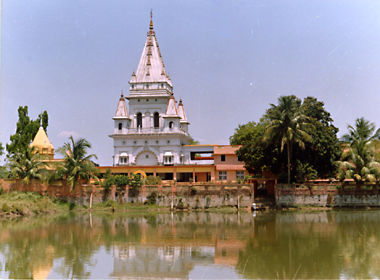
Sri Yogapitha
Devotee: There is a doubt circulating among some devotees about the authentic location of 'Mayapura,' the birth site of Sri Caitanya Mahaprabhu. There is also a controversy among some devotees about the Adbhuta-mandira. Will you please say something to clarify these issues?
Swami Narasingha: Some sahajiyas and mundane academia such as Jan Bzrezinski claim that Sri Caitanya Mahaprabhu's birth site is in Ramacandrapura (a suburb of modern Navadvipa town). However, according to the text of "Bhakti-ratnakara" Mayapura (Yogapitha) is located in Antardvipa, on the eastern bank of the Ganga.
Ramacandrapura in modern Navadvipa is located in Modrumadvipa on the western bank of the Ganga. Thus the site claimed by the sahajiyas as the birth site of Mahaprabhu could not be the original location. As for the Adbhuta-mandira - Iskcon has recently claimed that they are building the Adbhuta-mandira predicted by Sri Nityananda Prabhu. However, the skyscraper temple constructed at Yogapitha (Mayapura) by Bhaktisiddhanta Sarasvati Thakura in 1935 has been accepted by paramahamsa Vaisnavas for the past 69 years as the Adbhuta-mandira. Thus Iskcon could not be building what has already been built.
When we speak of Mayapura we do not mean any temporal or mundane location in this material world. Mayapura is the epicenter of the Lord's pastimes in eternity. This Mayapura manifested at the time of Sri Caitanya Mahaprabhu's appearance in 1407 Sakabda (1486 CE) and has since sometimes been manifest and sometimes not manifest. This is the nature of eternal truth. It is sometimes appearing and sometimes disappearing. This is called prakata and aprakata-lila.
The name of 'Mayapura' is found in Bhakti-ratnakara, Urdhvamnaya-tantra, Brahma-yamala, Ananta-samhita, Krsna-yamala and Kapila-tantra, although it is not mentioned in either Caitanya-caritamrta or Caitanya-bhagavata.
Caitanya-caritamrta and Caitanya-bhagavata make specific mention of 'Navadvipa' meaning 'nine islands'. At the time of Mahaprabhu's appearance Navadvipa was known as 'Nadia', which is the corrupted form of the name 'Naudiya', meaning 'new place'. The 'new place' was originally established by King Laksmana Sena of Vikrampura on the eastern side of the Ganga. Only after Mahaprabhu performed His pastimes in various places in 'Nadia' did the area become known among the Vaisnavas as Navadvipa. The area 'Navadvipa' encompasses all the places of the Lord's pastimes - including Antardvipa the place of His appearance or Mayapura.
In modern day Navadvipa there is a place referred to by some sections of the sahajiya community as Prachina Mayapura or 'old Mayapura'. This name Prachina Mayapura only came into use in 1928 nearly 41 years after Srila Bhaktivinoda Thakura and Srila Jagannatha Dasa Babaji discovered the location of Mayapura, the birth site of Mahaprabhu, on Antardvipa.
It is mentioned in Bhakti-ratnakara that Mayapura is located in Antardvipa (on the eastern bank of the Ganga), which was sometimes known as 'Atopura'. This is described in detail by Narahari Cakravarti Thakura.
According to the sahajiya account, Mahaprabhu's birth-site is in Ramacandrapura where it is alleged that the dacoit-king Vira Hamvira (who ruled Visnupura from 1586-1621) had built a temple. According to reliable records Vira Hamvira was a disciple of Srinivasa Acarya but there are no records of his ever having built a temple at Navadvipa to celebrate the appearance place of Sri Caitanya Mahaprabhu. Thus the account of the temple allegedly constructed by him is only hearsay.
The sahajiyas further contend that when the alleged temple built by Vira Hamvira was destroyed by the movement of the River Ganga, that later on, the chief adviser to Lord Hastings, Divan Ganga-govinda Singh, rebuilt it on the same spot with red sandstone in 1792. Floods from the Ganga claimed this temple in 1876. It is well known that the temple built by Divan Ganga-govinda Singh housed Deities of Sita-Rama and not a Deity of Sri Caitanya Mahaprabhu. Indeed this is unusual if we are to accept that the temple built by Ganga-govinda Singh was constructed to celebrate the birth site of Sri Caitanya!
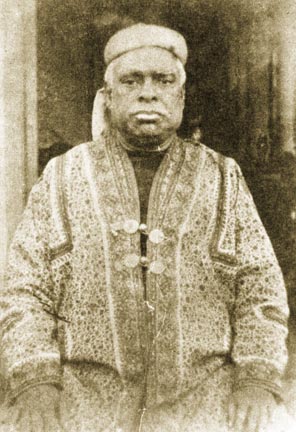 When Bhaktivinoda Thakura visited Navadvipa town he wrote that he was very unhappy with what he found.
"Every Saturday, I went to Navadvipa to search out the places of the lila of the Lord, but I did not find many and I was very unhappy. At the present time the people of Navadvipa only pay heed to their stomach etc. They do not make even a little effort in relation to the places of the lila of the Lord."
Bhaktivinoda continued his search and after years of research, earnest prayer and at last a divine revelation, the site of Mahaprabhu's appearance place was revealed to him in a vision. Bhaktivinoda spoke of this as follows:
"One night, Kamala and a clerk and I went up on the roof in order to look around. It was 10 o'clock, and was very dark and cloudy. Across the Ganga, in a northerly direction, I saw a large building flooded with light. I asked Kamala [if he saw it] and he said he had. I asked the clerk and he said, "I did not see anything." Because of that I was utterly amazed. In the morning I looked carefully at the place [where I saw the building] from the roof of Rani's house, and I observed that there was one Tal tree in that location. When I asked others about this place they said that this distant place was known as Ballal-dighi and that the remains of the fort etc. of Laksmana Sena were close by. That Monday I returned to Krishnanagar and the following Saturday I went back to Ballal-dighi. I saw that wonderful phenomenon in that place again at night, and the next day I went to see the area on foot. Upon inquiring with the elderly people of that place (Muslims), I was informed that this was the birthplace of Sriman Mahaprabhu. I gradually saw everything [in the area] and ascertained where all the small villages mentioned in the Caitanya-bhagavata and in Narahari Thakura's Bhakti-ratnakara and Parikrama-paddhati were."(Svalikhita Jivani by Srila Bhaktivinoda Thakura)
Professor Nishi Kantha Sanyal, a disciple of Bhaktisiddhanta Sarasvati Thakura, has written in this connection as follows:
"To the person with any antiquarian sense the difficulty is all but solved by the traditions that linger still in the village itself. We know from the villagers that the present Mohammedan inhabitants, who are in occupation of part of Mayapura, are the descendants of recent immigrants. The village was in a depopulated condition before the coming of the Mohammedans. That it was at one time a place of residence of Vaisnavas is also known to these Mohammedans. They also know that it is the Birth-place of Sri Caitanya. They have inherited some names of the different parts of the village such as Vairagi-danga (Vairagi's mound), Kholbhangar-danga (mound where the khol was broken), Barajpota (Brajapattan), Siva-doba (Siva's pool), etc. These names refer to famous incidents in the career of Sri Caitanya and the Vaisnava tradition. There are also current in the village highly significant superstitions. The Tulasi plant grew perennially all over one of these un-occupied homestead lands. Those who had attempted to occupy the land for purpose of habitation or even for cultivation, found that all crops are inevitably destroyed by the irrepressible Tulasi plants and some terrible harm befalls the occupant. Everyone is also cautioned against disturbing any portion of that particular mound in any way. Many had suffered terribly for trying to do so. That mound is sacred ground, because Nimai was born there. The Mohammedan inhabitants make offerings to the shrine that was subsequently erected on the spot. They firmly believe that the place possesses supernatural qualities. It would be worthwhile to collect all the current-stories which are fast becoming mythology as the villagers are becoming irreverent and partisan by outside influence.
"That these traditions were naturally taken to be genuine is proved by the fact that when the site was identified forty three years ago by Thakura Bhaktivinoda as the village Mayapura where Sri Caitanya was born, no person belonging to the locality disbelieved him. As a matter of fact there was no opposition from any quarter at that time and for a long period afterwards." (The Harmonist, Vol-28, January 1931)
Bhaktivinoda Thakura confirmed the location of Mahaprabhu's birth site with the help of Jagannatha Dasa Babaji, the most respected and senior Vaisnava of the times. This incident occurred in 1887. Bihari Dasa Babaji, the servant of Jagannatha Dasa Babaji, remembers this occasion:
"Once Bhaktivinoda Thakura arrived at the residence of Jagannatha Dasa Babaji with a kirtana party. The party, accompanied by Babaji Maharaja then quickly advanced towards Sri Mayapura. During this time another kirtana group was approaching from the Vamana-pukura side. The two parties chanting the glories of Sri Caitanya assembled together at the place of the present day Yogapitha. Over the age of 130 years, Jagannatha Dasa Babaji, being humpbacked, normally could not sit in an erect position. But when he would perform the congregational chanting of the Lord's holy name he would extend his body by the distance of five hand lengths and spring upward a distance of over one meter! How wonderful it was when he pointed out the location of Sri Caitanya Mahaprabhu's appearance site. It is also still fresh within my mind the way he struck his stick on the ground with a resounding "crack". He pointed out some distance away, a well that contained the broken hull of a mrdanga. Sometimes Jagannatha Dasa Babaji would chastise persons who were opposed to the authenticity of Sri Mayapura." (Interview, Gaudiya Magazine-1928)
The Yogapitha at Mayapura was also accepted as the birth site of Sri Caitanya Mahaprabhu by such great Vaisnava personalities as Gaura-kisora Dasa Babaji and Vamsi Dasa Babaji. Once a charlatan devotee claimed he had a dream that Yogapitha was in modern Navadvipa but this was sharply contested by Gaura-kisora Dasa Babaji and Vamsi Dasa Babaji. Gaura-kisora dasa Babaji said,
"Those great personalities who have discovered the birthplace of Sri Caitanya Mahaprabhu are to be followed. Simply because this person has had a dream that this is the birthplace of Sri Caitanya is not proof in itself. Those persons to whom holy places of pilgrimage are manifested never collect money with the intention of finding other holy places. Those persons who are actually followers of Sri Caitanya are able to find the place where Sri Caitanya was born. The way in which Bhaktivinoda Thakura and Jagannatha Dasa Babaji Maharaja discovered Mahaprabhu's birth place must be taken as a real fact."
"Then on the following day Vamsi Dasa Babaji, taking one small shovel in his hand, went to the place where that person was preaching that he was representing the original birthplace of Sri Caitanya. Vamsi Dasa gradually began to cut down the fence in front of that place. He showed the people how it was improper that this person was imitating that which had already been discovered by previous acaryas." (From 'An Era Not to be Forgotten' printed in The Gaudiya)
After Bhaktivinoda Thakura and Jagannatha Dasa Babaji had established Mayapura as Mahaprabhu's birthplace, one Sashibhushana Bandyopadyaya wrote in a periodical called "Pallavasi Patrika" that the real Yogapitha was somewhere in the district of Ramacandrapura. Although his statements were only based on hearsay there was a protest by the sahajiyas followed by a court case. There was no evidence to prove that the previous site where Ganga-govinda Singh had built a sandstone temple had ever been recognized as the birth site of Mahaprabhu. There were hundreds of elderly people living in Navadvipa at that time who had visited the sandstone temple dedicated to Sita-Rama, before its being claimed by the flood water of the Ganga, but none of them could come forward to the courts to say that they remember that temple commemorating the birth site of Sri Caitanya.
The court ruled in favor of Bhaktivinoda and stated that further evidence was needed in order to establish any claim of Mahaprabhu's birthplace being in the modern town of Navadvipa.
The sahajiyas began to take other steps to disprove the authenticity of the Mayapura birth-site on Antardvipa but to no avail. Then in 1916 (two year after the disappearance of Bhaktivinoda), one Vraja-mohana Dasa Babaji tried to find archeological evidence to disprove Bhaktivinoda's claims. It is said that he dug more that 700 holes in the modern Navadvipa area along the Ganga until at last he finally found a piece of red sandstone - which in the end did not verify anything.
It is mentioned in the book "Sarasvati-jayasri" that Vraja Mohana soon after approached the Gaudiya Matha and agreed to publish his findings in favor of the Mayapura discovered by Bhaktivinoda if they would bear the financial expenses for publishing his maps and book. When the Gaudiya Matha refused, Vraja Mohana became angry and swore to wreak havoc. Eventually the dubious findings of Vraja Mohana were published in a book entitled 'Navadvipa-darpana' with the help of the famous map publisher, Sri Dvijendranath Dhara. Later however, Dvijendranath Dhara admitted that he was sad that such an erroneous book had been published with his help because the contents of the book and its maps were full of fallacious additions and mistakes.
The courts never accepted the findings of Vraja Mohana as evidence in the case - thus in 1934 the government of India represented by the Honorable Governor Anderson of Bengal (the third most politically influential person in the British Empire) made an official proclamation that the birth site of Sri Caitanya Mahaprabhu was none other than the Yogapitha in Sridhama Mayapura established by Bhaktivinoda Thakura, Jagannatha Dasa Babaji and their followers.
"The Devils work is never done" -- still the istaka-vadis (followers of Vraja Mohana's brick philosophy) and other sahajiyas continue to beg the question and attempt to dispute the actual birth site of Mahaprabhu, but this is of little consequence in the face of Sri Caitanya's eternal service being spread throughout the world from Yogapitha at Sridhama Mayapura.
It has been predicted by Sri Nityananda Prabhu that the eternal service (nitya-seva) will manifest (vikasa) from a wonderful temple (adbhuta-mandira) constructed on the birth site of Sri Caitanya.
adbhuta-mandira ei haibe prakasa
gauranga nitya-seva haibe vikasa
"A wonderful temple will appear, from where Lord Gauranga's eternal service will manifest." (Sri Navadvipa-dhama Mahatmya, ch-5)
After establishing the place of Sri Caitanya's birth Bhaktivinoda Thakura set out to fulfill Sri Nityananda Prabhu's prediction of the Adbhuta-mandira at Mayapura and this was later taken up by Bhaktisiddhanta Sarasvati Thakura who completed the Adbhuta-mandira in 1935.
That the temple at Yogapitha build by Sarasvati Thakura is the Adbhuta-mandira predicted by Sri Nityananda Prabhu is confirmed in the following excerpt from an article "Opening Ceremony of the Lord's Temple."
"When Sriman Jiva Gosvami Prabhu was performing Navadvipa parikrama, Nityananda Prabhu told him about Sri Mayapura:
cari-sata-varsa gaura-jana dhari
haile sri murti seva habe sarvopari
"Four hundred years after Sri Caitanya Mahaprabhu's appearance, the worship of His Deity will manifest and He will be worshipped in a magnificent manner."
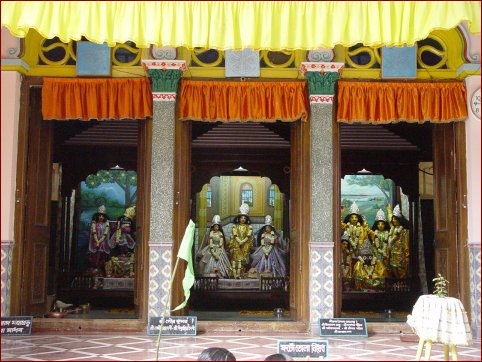
"This prophecy of Sri Nityananda Prabhu was fulfilled. We hear even more from the mouth of Sri Nityananda:
punah kabhu prabhu techa habe balavan habe mayapure ei rupa vasasthana
adbhuta mandira ei haibe prakasa gauranga nitya-seva haibe vikasa
"By the Lord's desire, this place will become prominent again and people will live in Mayapura as before. A wonderful temple (Adbhuta-mandira) will appear, from where Lord Gauranga's eternal service will manifest."
"Then, in 448 Gaurabda, in order to fulfill Sri Nityananda's prediction, the great soul Bhakti Vijaya (disciple of Sarasvati Thakura) dug the foundation for the great temple (Adbhuta-mandira) at Yogapitha. Following the desire of Sri Gaura's associate, the Deity of Adhoksaja Visnu, Who was worshipped in the house of Sriman Mahaprabhu, manifested Himself from the earth in the presence of a large number of people on Wednesday 15th June 1934.
"Let the inhabitants of the world see with their own eyes and feel within the core of their hearts how these statements of Sri Nityananda Prabhu have been fulfilled by one who is non-different from Nityananda Himself. Today, by the grace of Sri Nityananda's manifestation of Sri Gurudeva, the Bhakti-vijaya-pataka (the flag of pure devotion) flies over the sky-scraping Adbhuta-mandira (at Yogapitha Sridhama Mayapura)." (Gaudiya Magazine, March 16th 1935)
Since the building of the Adbhuta-mandira by Bhaktisiddhanta Sarasvati Thakura in 1935 the eternal service of Sri Caitanya has indeed manifest not only in Bengal and India but also throughout the world.
It is not stated anywhere that Krsna consciousness will first be preached globally and thereafter the followers of Sri Caitanya will come to Mayapura to do the Lord a favor by honoring His birth site with a temple. This is a gross misconception. Unfortunately, the members of modern day Iskcon think that their 'plan' to build a very large temple in Mayapura will be the fulfillment of the Adbhuta-mandira prediction. They unwittingly undermine the position and achievements of Bhaktivinoda Thakura and Bhaktisiddhanta Sarasvati Thakura.
The expertise of the 'propaganda machine' sometimes gets carried away in the 'self-adoration' society and arrives at erroneous conclusions. It should be pointed out however that all the disciples of Bhaktisiddhanta Sarasvati Thakura (including AC Bhaktivedanta Swami Prabhupada, Swami BR Sridhara Maharaja, Swami BP Kesava Maharaja, Swami BP Puri Maharaja and all others) accepted the temple constructed at Yogapitha as the Adbhuta-mandira predicted by Sri Nityananda Prabhu. In light of that, in the years that followed the opening of the Adbhuta-mandira there were many articles and essays that appeared in the Gaudiya, Harmonist, and other publications of Bhaktisiddhanta Sarasvati Thakura where it was mentioned that the construction of the temple at Yogapitha was the fulfillment of Sri Nityananda Prabhu's prediction.
In light of the fact that Bhaktisiddhanta Sarasvati Thakura is the parama-guru of every devotee in Iskcon one would think that Iskcon devotees would be sensitive and eager to understand Sarasvati Thakura's desires and contributions to the sampradaya, but surprisingly they show little or no interest. Other than maintaining a minimal regard for Sarasvati Thakura and the previous acaryas in our line -- for all practical purposes Iskcon leaders have 'divorced' Srila Prabhupada from the rest of the sampradaya by preaching apa-siddhanta everywhere and imitating achievements of previous acaryas in his name.
Many Iskcon leaders have said that they accept Srila B.P. Puri Gosvami Maharaja of Sri Gopinatha Gaudiya Matha in Mayapura as their siksa-guru, but at the same time they do not seem to care for his opinions on any topics other than salagrama and Deity worship. However, for their benefit Puri Gosvami Maharaja has spoken about the Adbhuta-mandira as follows:
"With the help of a wealthy disciple, the late Sakhi-caran Bhaktivijaya, Srila Prabhupada fulfilled Srila Bhaktivinoda Thakura's prediction of an extraordinary temple (Adbhuta-mandira) being built at Sri Yogapitha. When the foundation of the skyscraper temple was being dug, on June 13, 1934, a four-armed Deity of Visnu was discovered in the ground. Srila Prabhupada studied the Siddhartha-samhita and, according to the positioning of the weapons and symbols in the Deity's hands, identified it as Adhoksaja Visnu accompanied by His Sri, Bhu and Nila potencies. Several expert archeologists, including Sri Ramaprasad Chandra, attested to the Deity's antiquity. Srila Prabhupada commented later that this was the Deity formerly worshiped by Sri Jagannatha Misra himself. This beautiful Deity is currently being worshiped at the Yogapitha temple in Mayapura. (Translation of B.P. Puri Gosvami, in "Of Love and Separation - 'A few Glimpses at the Lotus Feet of Srila Prabhupada")
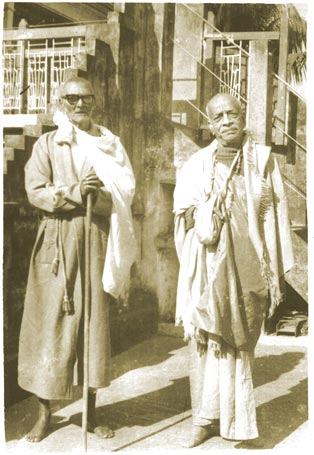
The members of Iskcon have conveniently forgotten that the idea to construct the "Planetarium" or "The Temple of Understanding", as it was called by Srila Prabhupada, was originally the idea, conception and desire of Srila B.R. Sridhara Maharaja of Sri Caitanya Sarasvata Matha. Sridhara Maharaja wanted to build such a temple in Koladvipa but found the project too ambitious for his means. He then decided to share his idea with an old admirable friend, Srila Prabhupada (A.C. Bhaktivedanta Swami Maharaja). Sridhara Maharaja remembers as follows:
"I asked Swami Maharaja (AC Bhaktivedanta Swami Prabhupada) to construct a temple where the whole Gaudiya Vaisnava philosophy will be demonstrated. I had a mind to construct such a temple here, but that was too ambitious and I could not do it. When I was told that he would build a temple there (in Mayapura), I humbly put forward my desire. I wanted a temple to be built according to the Brhad-Bhagavatamrtam of Srila Sanatana Gosvami. The whole structure of Gaudiya Vaisnava philosophy will be represented there in that temple. Bhur, Bhuvar, Svar, Mahar, Janar, Tapo and Satyaloka will be shown in a spiral way, and then Viraja, Brahma-loka, Para-vyoma, Goloka-Vrndavana. The idea is to demonstrate the structural position of Gaudiya Vaisnava theology, and from where Krsna has come down to this world to very kindly give us the clue to how we can be uplifted there, to the highest place. That should be dealt with in a scientific way.
 "Whoever comes to have the darsana of the temple will leave with an idea of the whole structure of all the religious conceptions to ever come into the world. The development is in a scientific basis. What is Bhur-loka? The land of experience of the five senses. Bhuvar-loka? Without this body, the mental experience world, and there are further gradations Svar, Mahar, Janar, Tapo. Bhu-loka is somewhat Prthviloka (Earth); there is also Preta-loka, the world of the dead; there is Deva-loka or Svar-loka, heaven; above Deva-loka is Mahar-loka where resides Bhrgu and other Rsis. Then there is Tapo-loka where the Catuhsana reside, and then Satya-loka of Lord Brahma.
"Then Viraja, the highest position aspired for by the Buddhists, prakrtilaya. And above that, brahmalaya, the end aspired for by the Sankarites; then Siva-loka, Bhakta-Siva, and Vaikuntha, the Land discovered and made known to the world by Sri Ramanujacarya. In that area of Para-vyoma, there are so many Vaikunthas in so many different phases of the pastimes of Lord Narayana who resides in the centre. Then above is Ayodhya with Ramacandra and the first introduction of vatsalya-rasa (Divine Parenthood). Then there is Krsna with many Queens in Dvaraka, and Krsna in Mathura. Again, in the Mathura sphere is Vrndavana, Govardhana, and Radha-kunda. From what standpoint does the theistic conception develop higher and higher - this is to be depicted. He (A.C. Bhaktivedanta Swami Prabhupada) accepted this plan and asked his followers to construct such a temple. But I am too old. He could not see it fulfilled, and perhaps I too may not see it." (Taped discourse, 1981)
Srila Prabhupada also confirms this in the following conversation:
Srila Prabhupada: I do not know for how long I will be able to carry on. So, I came to see Sridhara Maharaja.
Devotee: If you all go away, then the world will become dark.
Srila Sridhara Maharaja: [to Prabhupada] It is so wonderful that the will of the Lord becomes manifest through someone.
Srila Prabhupada: I want very much, Maharaja, that you come and stay at Mayapura. Because Prabhupada [Bhaktisiddhanta] always desired that you preach. He told me quite a few times, "Why don't you pull him out?" [They both laugh.] You know, I also tried to some extent before, but somehow or other it did not work out. Now, why don't you come and stay at Mayapura? Srila Prabhupada told me also, "Sridhara Maharaja is one of the finest preachers." I want to take you everywhere. At least at the place we have in Mayapura, people are coming from all over the world. If you just agree, then whatever kind of building you want, I will arrange it for you. They are trying to build a house for me. So both of us will stay there. And whenever you want, you can come here to your matha.
Srila Sridhara Maharaja: Yes, as long as I am alive to fulfill [Bhaktisiddhanta] Prabhupada's desire.
Srila Prabhupada: This is my earnest desire. Since you could not go around the world and preach, at least stay there and people will come to you. I shall make that arrangement. If you stay, then it will be helpful to me also. Sometimes I need to consult with someone and there is no one. There is no one that I can consult with. I feel this deficiency very greatly.
Devotee: If he [Srila Sridhara Maharaja] stays in Mayapura, all kinds of people will get to hear from him.
Srila Prabhupada: Yes, that's right.
Srila Sridhara Maharaja: Yes, people from all kinds of cultural backgrounds will come there.
Srila Prabhupada: Yes, and they are already coming. And in that house I will make arrangements for an elevator so that you won't have to go through the difficulty of walking up and down the stairs. You won't even have to move a step yourself. I'll make arrangements for a car and an elevator. My disciples are telling me that they will build a house for me. So, both of us will stay in that house. Most of the time I am traveling around, so if you are there, they can get some guidance. So, Maharaja, please, give me the order and I will make all the arrangements for you.
That Planetarium [The Temple of Understanding] also will be built under your direction. My idea is to combine the Indian culture and the American money--the lame man and the blind man policy. I tell them also that this will be very beneficial for the world." (Excerpt of 1977 conversation at Sri Caitanya Sarasvata Matha, transcription by Bhakti Caru Swami)
For decades Iskcon leaders have struggled with the concept of what "The Temple of Understanding," now being referred to by them as the "Adbhuta-mandira," will represent. This is due to their having neglected to humbly approach the original architect of "The Temple of Understanding" to find out what was his conception of such a grand temple.
Of course that is all in the past and the original plans for the Iskcon "Temple of Understanding" (sometimes now being called "The temple of Misunderstanding") have now been reduced in size by 70% from what they were in the time of Srila Prabhupada. This has come about due to the fall downs of numerous Iskcon gurus and project financiers.
Even though Iskcon only has a plan on 'paper' to build their temple, still, self-adoration dictates to them that their paper plan is the 'Adbhuta-mandira' (ignoring the glory of the Adbhuta-mandira already constructed at Yogapitha). Such are the effects of false pride. It is improper or offensive, as Vamsi Dasa Babaji has demonstrated above, for devotees to imitate that which has already been done by previous acaryas. But as already mentioned, the proposed Iskcon temple is now 70% less 'adbhuta' than as originally conceived of by Srila Prabhupada and it unfortunately bears none of the original theistic conception outlined above by Srila Sridhara Maharaja. Even the Deity conception at Iskcon Mayapura is no longer the same as originally given by Srila Prabhupada (see Temple of Understanding - article from Krsna Talk #49 for further details).
The onus is now on Iskcon leaders to either accept that the Adbhuta-mandira as predicted by Sri Nityananda Prabhu was built by Bhaktisiddhanta Sarasvati Thakura at Yogapitha or it is up to them to prove via guru, sadhu, and sastra that the temple at Yogapitha is not the Adbhuta-mandira. The latter would not be advisable, for as Professor Sanyal has cautioned in his article above -- anyone who tries to bear harm to Yogapitha runs the risk of meeting with "terrible suffering".
If Iskcon wants to remain connected to the Gaura-sarasvata-parampara (rupanuga-sampradaya) then they would do well to accept the above conclusions or they are destined to continue on the path of becoming an apa-sampradaya (pseudo-disciplic succession).
Additional Supporting References available bellow:
Excerpt from 'The Gaudiya' Magazine, 9th March, 1934
Fulfillment of Bhaktivinoda's instruction and desire
Excerpt from 'The Gaudiya' Magazine, 20th March, 1934
New Temple opened as reported in the Navadvipa-dhama Pracarini Sabha.
Excerpt from 'The Gaudiya' Magazine 1934
Report on the Adbhuta-mandira & Bhaktivinoda's prediction
A study for Sri Caitanya's Birth Place
An unbiased academic study by Prof. K.N. Mukherjee on the authenticity of the present Yogapitha temple in Mayapura, taken from 'The Indian Journal of Landscape Systems and Ecological Studies 1984' (revised in 1990).
The Holy Birth Place of the Supreme Lord Sri Krishna Caitanya
An article by Prof. Nishi Kanta Sanyal, disciple of Srila Bhaktisiddhanta Sarasvati Gosvami Prabhupada, taken from The Harmonist magazine Vol. 28. 1931. Prof. Sanyal explains both the academic and transcendental evidences to authenticate the Mayapura birthsite.
Evidence from the Book 'Citre Navadvipa'
Some notes from the book 'Citre Navadvipa' published in 1930 by Sriyukta Saradindu Narayana Raya, secretary of the Navadvipa-dhama Pracarini Sabha. This book has many evidences including discoveries made by the famous Bengali historian Sri Nagendranath Basu.
A New Temple on the Birth Site of the Supreme Lord Sri Krishna Caitanya
A short article reporting the opening of the Yogapitha temple in 1935, with additional background information.
The Topography of Sridhama Mayapura
An article from The Harmonist 1931 which gives additional evidence pointing to the birth site of Sri Caitanya Mahaprabhu.
The Prediction of Vrndavana Dasa
An extract from an article entitled "The Full Moon of the Advent of Lord Gauranga" from The Harmonist, Vol. 15 1935. This essay mentions the prediction of Srila Vrndavana Dasa Thakura in Sri Caitanya-bhagavata about the discovery of Mayapura.
The Opening Ceremony of the Lord's Temple
An excerpt from a Bengali article found in The Gaudiya magazine written in 1935, explaining the prediction of Sri Nityananada Prabhu and it's fulfillment by Srila Bhaktivinoda Thakura and Srila Prabhupada Sarasvati Thakura.