
Among Hindu rituals there is perhaps no one ritual more well known than the arati ceremony. Anyone who has visited a Hindu temple has been allured, or due to insufficient knowledge perhaps frightened, when the lamp of fire passes from the altar to the congregation and circulates from person to person. The origin and significance of this colorful ritual speaks of its inner charm and potential to dispel all fear arising from the ignorance of material identification.
The Sanskrit word arati literally means "before night." Ratri (night) when prefaced with the letter a indicates dusk. The waving of the lamp before the Deity thus implies the dispelling of the night of our material sojourn with the light of devotion through which God is revealed.
In addition to the lamp, the traditional arati includes other items, which along with the lamp correspond with the eightfold material elemental constituents. In the Bhagavad-gita, Sri Krsna mentions these elements thus:
bhumir apo 'nalo vayuh kham mano buddhir eva ca
ahankara itiyam me bhinna prakrtir astadha
"Earth, water, fire, air, ether, mind, intelligence, and material ego, these eight elements constitute my separated material energy."
These material elements, five gross and three subtle, cover our soul. Corresponding with the gross material elements are the senses and sense organs: earth-smelling (nose); water-tasting (tongue); fire-seeing (eyes); air-touching (skin); and ether-hearing (ears). These five senses make up our physical dimension, while mind, intelligence, and material ego make up our psychic dimension. Under all of this we reside, like a diamond in the rough. Although our consciousness is covered by a mountain of material misconception causing us to identify ourselves with our body and mind, its potential to shine remains undiminished. Rituals such as arati are intended to remove the mountain of our misconception, as well as shed light on our positive potential in a life of transcendental love.
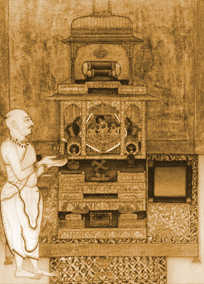
During the arati, first and foremost the devotee offers himself. In so doing, he removes ahankara, the material ego. He identifies no longer as the material body and mind. He identifies not with his personality derived from material association and experiences, rather with the notion that he is a servitor of the Deity. Thus in preparation for performing the arati, the devotee will often perform bhuta-suddhi, a ritual in which one adopts the ego of a servant. He may think of himself as such in a general sense or, in more advanced stages, in terms of his particular awakened siddha rupa,the perfected spiritual body in which he will participate eternally in Krsna's lila. A typical mantra chanted during the bhuta-suddhi in the Gaudiya Vaisnava lineage is one that Sri Chaitanya himself chanted.
naham vipro na ca nara-patir napi vaisyo na sudro
naham varni na ca grha-patir no vanastho yatir va
kintu prodyan-nikhila-paramananda-purnamrtabdher
gopi-bhartuh pada-kamalayor dasa-dasanudasah
"I am not a brahmana; I am not a ksatriya; I am not a vaisya or a sudra. Nor am I a brahmacari, a householder, a vanaprastha, or a sannyasi. I identify myself only as the servant of the servant of the servant of the lotus feet of Lord Sri Krsna, the maintainer of the gopis. He is like an ocean of nectar, and he is the cause of universal transcendental bliss. He is always existing with brilliance." (Padyavali 74)
In this mantra, Sri Chaitanya dismisses identification with the structure of varnasrama, the Vedic socioreligious system in which souls are classified in accordance with their physio/psychological karmic makeup. Reaching beyond religion, Sri Chaitanya identifies himself as a maidservant of Krsna, the eternal husband of the gopis. If one can perform the arati with this ego, one needs not a lamp and oil, for such a perfected sadhaka's eyes darting in sidelong glances serve as the lamp, and the prema of their hearts the oil.
In the traditional arati ceremony, the flower represents the earth (solidity), for all fragrance is found therein. The water and the accompanying handkerchief correspond with the water element (liquidity). The lamp represents the fire element (heat), the peacock fan the air (movement), and the yak tail camara fan the ether (space). The incense represents the purified state of mind, and one's intelligence is offered in the discrimination required with regard to timing and order. The priest offers these items with the right hand, while ringing a bell with his left hand. In the Gaudiya tradition, true to its emphasis on the efficacy of chanting the sacred names of God, the offering of all the arati items is preceeded by uttering the name of the Deity one is worshipping. Additionally, the Hari-bhakti-vilasa of Sanatana Goswami and Gopala Bhatta Goswami states that the blowing of the sankha, or conchshell, before and after the items are offered is essential. Thus during the arati, the devotee unravels himself from the entanglement of material nature by offering the Deity all of the material elements that color his consciousness. In the case of krama mukti (going step by step through all levels of consciousness, as Gopa-kumara did in Sanatana Goswami's Brhad-bhagavatamrta), the devotee will meet all of the deities presiding over the material elements and realize that they are eternally worshipping the supreme Deity. Those who perform arati can thus conceive that they are in presence of all of these deities in their purest expression of devotion to Krsna, an experience witnessed at the time of liberation.
Arati is both an individual activity performed regularly by the temple pujari and a public activity that devotees attend with great enthusiasm. During the arati the sweet aroma of pungent incense pervades the room, lights are dimmed, and gongs, bells, drums, and cymbals reverberate. Temples are traditionally illuminated by natural lighting, such as ghee or oil lamps, adding much to the mystical atmosphere that purifies all the participants.
Three types of purity are necessary for arati. The articles offered must be pure, dravya-suddhi. The offering procedure must be pure, kriya-suddhi, which depends on strictly following the instructions of revealed scripture and one's guru. And finally, the consciousness of the offerer must be pure, bhava-suddhi. One's consciousness is pure by having a service attitude and absorbing oneself in meditation. As bhava-suddhi intensifies, one enters into the spiritual world of Krsna lila, and the ritual becomes one's reality.
Many temples, which understand their Deity seva to be nondifferent from the direct service of Radha-Krsna, modify certain aspects of the worship according to changes in season and climate. During the coldest winter months in Vrndavana, the Deities are bathed with hot water and a burner of hot coals heats the Deity rooms. Going for darsana, one sees that gloves, hats, foot-warmers, shawls, and even earmuffs are offered to most Deities. In the peak of the hot season, from Candana-yatra to Sarat Purnima, flowers and incense replace the (hot) ghee lamp at the noon arati in the Radha-ramana temple in Vrndavana. Many festivals with grand flower arrangements are held, sometimes with water fountains and fine mists of aromatic scented water cooling the Deities. Other times, during the last evening arati, musical accompaniment is played very softly just before the Lord takes rest.
While arati is a ritual that purifies the heart, a ritual leading to higher reality, it is also a reality unto itself. Such is the nature of bhakti, for devotion is both means and end. As we have heard, even the gopis perform arati, thus there is arati for the sadhaka and arati for the siddha. The Gaudiya Vaisnava lineage advocates the raga-marga, the path of passionate love of Godhead. As the sadhaka qualifies himself for raganuga sadhana, his orientation toward the rituals of devotion changes. The path of raga requires that the sadhaka regularly contemplate the eternal lilas of Radha-Krsna, and thus in the beginning stages of raganuga bhakti, the sadhaka thinks of the arati ceremonies throughout the day in relation to the eightfold daily pastimes of Radha-Krsna. Indeed, it is from these pastimes that the arati ceremony derives.
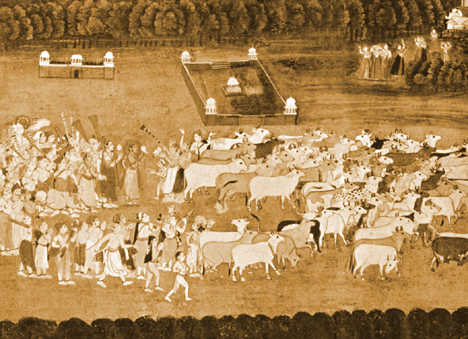
The eternal daily lila of Krsna is divided into eight sections that comprise the twenty-four hours from sunrise to sunrise. It is in the sunset pastime that the arati ceremony has its origins. At sunset Krsna returns from the forest with his friends and calves. The sun sets with embarrassment, acknowledging Krsna as the light of lights, who lights both day and night, defeating the splendor of the sun. All the residents of Vrndavana have been waiting impatiently for him throughout the day. Were it not for Krsna's friend Madhumangala and his appetite, Krsna might not return home, so absorbed he is in his sportive play with his friends. As he approaches the village, Nanda Baba, his father, sees him from the rooftop of his house and signals to all of his dear son's arrival. Decorated with the dust of the pasturing grounds raised by the hooves of his calves, Krsna appears more beautiful than when he left that morning. Mother Yasoda collects him in her arms, mildly admonishing him for his tardiness. She praises Madhumangala for bringing him home, as mother Rohini brings a ghee lamp to inspect Krsna's body for scratches incurred in his sportive forest play (although in fact they may be due to his secret rendezvous with the gopis ). The lamp dissipates the night and enhances the union of Krsna and his devotees, dispelling the pangs of their separation. From this lila, just before night, arati has its eternal beginning. The lamp of his devotees' love is thus held to the Krsna sun and that love-lamp itself is thus further illumined.

During the ritualistic day of the sadhaka, the day begins with mangal arati, one and a half hours before sunrise. This time corresponds with nisanta lila, the end of night and the waking of Radha and Krsna in the bowers of Vrindavana. While the beginning sadhaka views the arati as the end of the long night of his material slumber, and the dawning of his day of service to sri guru, the siddha envisions his soul's participation in the lila, assisting those waking Radha-Krsna and helping the divine couple to reach their homes before the sunrise speaks of their secret love to all. As ordinary souls dread the end of night and slumber on in ignorance, the sadhaka rises early to conquer the ignorance of sleep. Yet the ultimate soul, Radha-Krsna, dreads the sunrise in the lila of love, for it brings to a close the union of Radha and Krsna and gives rise the pangs of their daytime separation, in which their secret paramour love must remain hidden. Thus it is stated in Sri Gita:
ya nisa sarva-bhutanam tasyam jagarti samyami
yasyam jagrati bhutani sa nisa pasyato muneh
"What is night for all beings is the time of awakening for the self-controlled, and the time of awakening for all beings is night for the introspective sage." (Bg. 2.69)
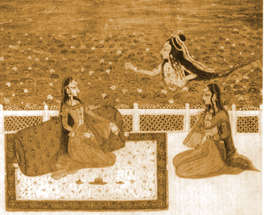 It is said in the Vedas that proportionate to the removal of darkness, the light of knowledge awakens in one's heart, and to that extent kama, the heart's longing, is destroyed. Yet it appears that in Vrindavana this is just the opposite. When the darkness of night comes to an end, the light of daybreak only increases the desire of Radha and Krsna to be united again. The customs of Vraja are beyond the reach of even the Vedas ! What is day for the sadhaka is night for those not treading the spiritual path. Yet what is day for the sadhaka is at the same time night for the siddha who lives in the lila of Radha-Krsna. The sadhaka takes joy in rising early to the new day, while the siddha laments in transcendental ecstasy over the separation of Radha-Krsna that the rising of the sun mandates. This transcendental lamentation is most desireable, and awakening to this ideal is mangal arati, the most auspicious arati of all.
Nisanta-lila: Pastimes at the End of Night
The brahma-muhurta, beginning an hour and a half before sunrise is the most spiritually auspicious time of day. The first and foremost arati of the day, mangala-arati, is performed during this time period, sometimes as early as 4 a.m. Any devotional activities performed during this time are greatly enhanced in terms of their spiritual potency and acquired benefits. Thus attendees are recipients of a heightened spiritual upliftment especially manifest during the brahma-muhurta. It is the pujaris good fortune to awaken the Deities by the melodious recitation of auspicious verses while gently massaging the Deities lotus feet.
Visvanatha Cakravarti Thakura has written in his Gurvastaka, a popular song revealing the exalted position of the spiritual master, that one who meticulously sings this song daily during the brahma-muhurta achieves spiritual perfection. Mangala-arati corresponds with the awakening of Sri Sri Radha and Krsna in their forest nikunja (grove) slightly before the rising of the sun. As their loving pastimes close for the night they hurry to their respective homes. Sadhakas meditate deeply at this auspicious time of day on this important pastime and the strong feelings of separation of Radha and Krsna as they part company. Sincere devotees who are eager to increase their devotional dedication, faithfully attend mangala-arati without fail.
Prata-lila: Morning Pastimes
After returning home and being awakened by Mother Yasoda, Krsna bathes and milks the cows, sometimes meeting Radha for pastimes at the Yamuna River. Here they may enjoy an early morning light meal, like sweets (Bala bhoga ). Srimati Radhika leaves for Nandagram to cook for Krsna in Mother Yasoda's kitchen. Similarly, after mangala-arati, sadhakas bathe the Deities, dress Them and feed Them various nicely prepared sweets and other preparations. Deity seva includes many opportunities for service of the highest order. Cooking many varieties of tasty foodstuffs to offer the Deities is a most important service, for this is reserved for Krsna's best servitors, Srimati Radharani, Mother Yasoda and their most qualified associates. Cleaning is another very important service--for cleanliness is next to Godliness. In the advanced stage of devotional service, one continuously remembers these eternal daily pastimes of the Lord and His associates, while engaging in their various Deity sevas.
Purvahna-lila: Forenoon Pastimes
Returning home once again, Krsna bathes and dresses for the forest, simply and elegantly with many flowers and other natural things such as peacock feathers, valuable jewels and gunja-bead malas. He wears a vaijayanti garland composed of at least five different colored flowers, which is always long enough to touch his knees or feet. Krsna decorates other parts of his body such as his head, neck and chest extensively with flower garlands. He then appears for his morning meal cooked by Sri Radha, after which he goes to the forest of Vrndavana with his cows and cowherd boy friends. Srimati Radharani also goes to the forest on the pretense of performing surya-puja, worship of the sun, but in actuality Her sole purpose is to meet Krsna at Radha-kunda. Sadhaka's meditate on these pastimes as they dress the Deities of Radha and Krsna in a mood of preparation for a day of forest sporting and perform the morning dhupa arati. Enthusiastic devotees eagerly await the darsana of the Deities in Their nicely dressed state with multicolored silken dresses adorned with beautiful jewelry and aromatic garlands of flowers.
Madhyahna-lila: Midday Pastimes
The noon raja-bhoga offering of a full meal to the Deities is their main offering of the day and corresponds to Krsna's lunch-often a forest feast send by Mother Yasoda. This happens amidst many wonderful and enchanting amorous pastimes with Sri Radha and her charming associate gopis in the many wonderful groves of Radha-kunda. At the time of the offering of these foodstuffs to the Deities, devotees traditionally sing the Bhaja Bhakata-vatsala, Bhoga-arati song of Bhaktivinoda Thakura for the pleasure of the Deities--a heartfelt expression of Krsna's enjoyment of the innumerable tasty preparations offered.
Aparahna-lila: Afternoon Pastimes:
Awakening from a midday rest (Utthapana ), Krsna joins the Surya puja disguised as a pujari and then returns home to bathe and dress for the evening. Similarly the Deities are awakened from Their afternoon rest, offered a light snack and arati.
Sayam-lila: Dusk Pastimes
The Sandhya-arati takes place at twilight, the sandhi or joining of day and night, just after the evening offering of foodstuffs. It is the time when Krsna takes his evening meal and after milking the cows takes rest. This is perhaps the most festive arati of the day with many enthusiastic visitors in attendance. This arati is also called the Gaura-arati by Gaudiya Vaisnavas, for they absorb themselves in thoughts of the arati of Sri Chaitanya Mahaprabhu singing the Kiba Jaya jaya gauracander song, vividly describing this arati.
Pradosa-lila: Evening Pastimes
The last darsana of the evening is called aulai darsana, arising from the Hindi word meaning to call or holler "last darsana." Krsna will no longer be available publicly--retiring to his inner chambers for the night, only to leave for his nightly rendevous with Sri Radha and close associates.
Nakta-Lila: Midnight Pastimes
Lord Krsna's most confidential pastimes take place at night in the bowers of Vrndavana. Here He engages in many wonderful lilas with His beloved gopis such as rasa-lila, water sports, amorous pastimes and sleeping. Devotees, realizing the inherent sweetness of this service, are happy to dress the Deities in nightclothes and after offering a light refreshment and short arati, invite the Deities to take rest. A perfect way to end the day.