
Following the transition from Newtonian classical physics to quantum mechanics, several scientists have explored the possibility of a connection between physics and transcendence.
For India's great realizers, the primary evidence in support of their theses is revealed scripture (sastra), such as the Vedanta-sutras. This evidence is considered to originate beyond the limits of human reasoning. Yet, especially for Westerners, as an introduction to the virtues of scriptural evidence, it may be prudent to first discuss the concept of a transcendental personal Godhead in the context of modern science and quantum mechanics in particular. Following the transition from Newtonian classical physics to quantum mechanics, several scientists have explored the possibility of a connection between physics and transcendence.
This may be due to the more abstract nature of quantum mechanics as opposed to classical physics. For example, classical physics attempts to describe the physical reality in concrete, easily understandable terms, while quantum mechanics deals in probabilities and wave functions. Quantum mechanics, however, is much more rigorous in its attempt to describe reality and explains phenomena that classical physics fails to account for. The "quantum leap" has given several physicists the hope that the transcendentalist's experience of consciousness can also be explained by the quantum mechanical theory. Although the quantum theory does not account for consciousness, it has become popular to attempt to bridge the gap between the transcendentalist's experience and the quantum mechanic world view. Some people have loosely called this the "new physics."
The rational spiritually-minded community cheered the appearance of Fritjof Capra's The Tao of Physics and Gary Zukav's Dancing Wu Li Masters. Later, David Bohm's The Implicate Order was similarly praised. Although there is good reason to applaud their work and the work of others like them, their theories, scientifically speaking, do not quite bridge the gap between physics and transcendence. However, these scientists have to some extent become "believers" and that is a major breakthrough. Furthermore, the theories have turned many educated persons in the spiritual direction.

Of all the recent attempts to show the "oneness" in what physicists and transcendentalists speak of, Bohm's implicate order theory is the most worthy of consideration. In comparison, Capra's "realization" that the dance of Shiva and the movement of atomic particles is one and the same — although profoundly beautiful — falls more in the realm of poetry than science.
Of course any attempt to find harmony between the scientific world view and the mystic's vision will be incomplete unless we adjust the scientific world view through an interface with the many realities it fails to account for (subtle bodies, consciousness, etc.). Taking that liberty, as Bohm has, Richard L. Thompson, Dr. of Mathematics and author of the book Mechanistic and Non-mechanistic Science, has postulated a new theory of "creation through sound" using what he calls The Vedic Paradigm.
Thompson advocates the philosophy of achintya bhedabheda, a transcendental conception which, interestingly enough, fits well with the example of the hologram (often used to illustrate Bohm's implicate order theory). This transcendental conception is different than the one Bohm advocates. Thompson attempts to show in his upcoming book, End of Physics, how some of the holes in Bohm's theory can be filled using an alternative view of transcendence, namely acintya bedhabedha.
Simply stated acintya bedhabedha means that reality is ultimately, inconceivably one and different at the same time. Bohm is an adherent of advaita vedanta or non-dualism. Non-dualists percieve reality as one homogenious substance. In their view all forms of variety and individuality are products of illusion. Acintya bedhabedha, holds that the world of material variety is illusory but not altogether false. It insists that there is a transcendental variety and spiritual individuality that lies beyond illusion. Acintya bedhabedha is a theistic conception and advaita vedanta is monistic or atheistic.
Thompson is a practicing scientist who has been pursuing transcendental disciplines for the last thirteen years. This kind of combination is rare. It is hard to find someone who is thoroughly familiar with science as well as with spirituality. In order to appreciate his theory of creation by sound it will be helpful to first briefly explain Bohm's theory of the implicate order and then proceed to further elaborate on the philosophy of acintya bedhabedha. Such explanations will serve as a peface to the discussion of creation, all of which shed new light on the nature of reality, helping to harmonize physics and metaphysics.
The Implicate Order
Bohm's explanation of reality involves an "implicate" and "explicate" order, with vague references to love, compassion, and other similar attributes that may lie beyond both the implicate and explicate. The implicate order is an ultimate physical substrate which underlies our present perception of reality. The reality that we perceive is what Bohm calls the explicate order. All order and variety, according to Bohm, are stored at all times in the implicate order in an enfolded or unmanifested state. Information continually unfolds or becomes manifest from the implicate order as the explicate order of our experience.
Of course any attempt to find harmony between the scientific world view and the mystic's vision will be incomplete unless we adjust the scientific world view through an interface with the many realities it fails to account for.
Bohm uses the example of the hologram to help explain his theory. A hologram is a photographic plate on which information is recorded as a series of density variations. Because holography is a method of lensless photography, the photographic plate appears as a meaningless pattern of swirls. When a coherent beam of light -- typically the laser -- interacts with the plate, the resultant emerging light is highly ordered and is perceived as an image in three dimensions. The image has depth and solidity, and by looking at it from different angles, one will see different sides of the image. Any part of the hologram will reproduce the whole image (although with less resolution). Bohm would say that the three-dimensional form of the image is enfolded or stored in the pattern of density variations on the hologram.
A further understanding of the nature of Bohm's implicate order is somewhat more difficult to grasp. In the transition from the classical description of physical objects to a quantum mechanical description, one is forced to use mutually incompatible descriptions. That is, to understand the behavior of electrons, it is necessary to describe them as point-like particles and extended waves. This concept of complementarity, devised in the 1920's by the physicist Niels Bohr, leads naturally to the thought that electrons, or their ultimate substrate, may not actually be fully describable in mathematical terms. Thus the ultimate physical reality may be an undefinable "something" which is only partially describable but not fully, because some of the partial descriptions will inevitably contradict each other. This is Bohm's idea regarding the nature of his implicate order.
Although Bohm accepts the reality of a whole containing distinguishable parts, he maintains that ultimately, reality at its most fundamental level is devoid of variety or individuality. Bohm believes that individuality is a temporal or illusory state of perception. According to his theory, although the parts appear to be distinct from the whole, in fact, because they "enfold" or include the whole, they are identical with the whole.
The intuitive basis behind this idea of wholeness is that when information is enfolded into a physical system, it tends to become distributed more or less uniformly throughout the system.
The hologram provides an easily understandable example. If portions of a hologram are blocked off, the resultant image remains basically the same. This, perhaps metaphorically, helps to illustrate the concept that the whole is present in each of its parts. Consider then a continuum in which all patterns ever manifested in any part of the continuum are represented equally in all parts. Loosely speaking, then one could say that the whole of the continuum in both space and time is present in any small part of the continuum. If we invoke the precedent of quantum mechanical indefinability, we could leap to the idea of a unified entity encompassing all space and time in which each part contains the whole and thus is identical to it. Because wholes are made up of parts, such an entity could not be fully described mathematically, although mathematical descriptions could be applied to the parts.
Thompson's Observations
Although Bohm's theory of the implicate order is partially based on the standard methodology of physics, it is also apparent that it involves ideas that are not found in traditional science. Most of these ideas are clearly the influence of a preconceived notion of non-dualism.
Bohm's theory is sorely in need of a logical source of compassion which provides inspiration enabling finite beings to know the infinte. Ironically while Bohm emphatically states that it is not possible for unaided human thought to rise above the realm of manifest matter (explicate order) he proceeds to carry on a lengthy discussion about the unmanifest (implicate order). Although he speaks of compassion it is only in a vague reference to an abstract attribute. The logical necessity for an entity possesed of compassion is avoided by Bohm (although he almost admits the need). He retreats from this idea because the standard notions of a personal God are dualistic and thus undermine the sense that reality at the most fundamental plane is unified.
Bohm's idea that the parts of the implicate order actually include the whole is not fully supported by his physical examples alone. Indeed this is impossible to demonstrate mathematically. The part of the hologram is not fully representative of the whole. The part suffers from lack of resolution. It is qualitatively one but quantitatively different.
Bohm's account for the corruption in human society is also a short coming in an otherwise profound theory. The theory alleges that evil arises from the explicate order -- which is a contradiction of the basis of the theory which states that everything in the explicate order unfolds from the implicate order. This means that evil and human society at large or something at least resembling it must be originally present in the implicate order. But what would lead us to believe that an undifferentiated entity would store anything even remotely resembling human society? Or how could there be evil in or beyond the implicate order which is the source of love and compassion?
Bohm states that the totality of all things is timeless and unitary and therefore incapable of being changed. Later on he proposes that through collective human endeavor the state of arrairs can be changed. This is similar to the contradiction of advaita vedanta in which ultimate oneness is thought to be attained even though it is beyond time and forever uninfluenced by our actions.
These are some of the scientific and philosophical problems with the theory of the implicate order pointed out by Thompson. They are resolved by Thompson by replacing advaita vedanta with achintya bedhabedha.
Achintya Bhedabheda
The history of philosophy bears evidence that neither the concepts of oneness (non-dualism) or difference (dualism) are adequate to fully describe the nature of being. Exclusive emphasis on oneness leads to the denial of the world and our very sense of self as an individual -- viewing them as illusion. Exclusive emphasis on difference divides reality, creating an unbridgeable gap between man and God. Both concepts at the same time seem necessary inasmuch as identity is a necessary demand of our reason while difference is an undeniable fact of our experience. Therefore a synthesis of the two can be seen as the goal of philosophy. In the theory of achintya bhedabheda, the concepts of both oneness and difference are transcended and reconciled in this higher synthesis, and thus they become associated aspects of an abiding unity in the Godhead.
The word achintya is central to the theory. It can be defined as the power to reconcile the impossible. Achintya is that which is inconceivable on account of the contradictory notions it involves, yet it can be appreciated through logical implication.
Achintya, inconceivable, is different from anirvacaniya, or indescribable, which is said to be the nature of transcendence in the non-dualistic school. Anirvacaniya involves the joining of the opposing concepts of reality and illusion, producing a canceling effect -- a negative effect. Achintya, on the other hand, signifies a marriage of opposite concepts leading to a more complete unity -- a positive effect.
Just as the eye cannot see the mind but can be in connection with it if the mind chooses to think about it, so similarly the finite can know about the infinite only by the grace of the infinite.
It may be helpful to draw upon a reference from Vedic literature. Actually, the example of the hologram is similar to an explanation of the basis of reality recorded in the Brahma Samhita. There we find a verse in which, ironically, Godhead has been described as personal and individual and Who, at the same time one with and different from His energies.
He is an undifferentiated entity as there is no distinction between potency and possessor thereof. In His work of creation of millions of worlds, His potency remains inseparable. All the universes exist in Him and He is present in His fullness in every one of the atoms that are scattered throughout the universe at one and the same time. Such is the primeval Lord whom I adore. (Brahma Samhita 5.35)
In the material conception of form, the whole can be reduced to a mere juxtaposition of the parts. This makes the form secondary. In this verse the material conception of form is transcended. The supreme entity is fully present in all of the parts which make up the total reality and thus the supreme is one unified principle underlying all variegated manifestations. Yet He is personal and in this feature different from his parts or energies at the same time. The Brahma Samhita goes on to say that each of the parts of the Godhead's form are equal to each other and to the whole form as well. At the same time each of the parts remains a part. This is fundamental to the philosophical outlook of achintya bhedabheda. It allows for the eternal individuality of all things without the loss of oneness or harmony. It also allows for the possibility that man, even while possessed of limited mind and senses, can come to know about the nature of transcendence. The infinite, being so, can and does reveal Himself to the finite. Just as the eye can not see the mind but can be in connection with it if the mind chooses to think about it, so similarly the finite can know about the infinite by the grace of the infinite. The concept of non-dualism however allows for neither of these things.
In the Bhagavad Gita we find the following verse: (9.4)
By Me in My unmanifested form this entire universe is
pervaded. All beings are in Me, but I am not in them.
Although this is inconceivable -- achintya -- an example drawn from material nature may help us to understand this concept (logical implication). We cannot think of fire without the power of burning; similarly, we cannot think of the power of burning without fire. Both are identical. While fire is nothing but that which burns; the power of burning is but fire in action. Yet at the same time, fire and its burning power are not absolutely the same. If they were absolutely the same, there would be no need to warn our children that "fire burns." Rather it would be sufficient to say "fire." Furthermore, if they were the same, it would not be possible to neutralize the burning power in fire through medicine or mantra without causing fire to disappear altogether. In reality the fire is the energetic source of the energy which is the power to burn. From this example drawn from the world of our experience, we can deduce that the principle of simultaneous oneness and difference is all pervading, appearing even in material objects.
Just as there is neither absolute oneness nor absolute difference in the material example of fire and burning power, there is neither absolute oneness nor absolute difference between Godhead and His energies. Godhead consists of both the energetic and the energy, which are one and different. Godhead is also necessarily complete without His various emanations. This is absolute completeness. No matter how much energy He distributes, He remains the complete balance.
In this theory the personal form of God exists beyond material time in a trans-temporal state, There eternality and the passage of time are harmonized by the same principle of simultaneous oneness and variegatedness that applies to transcendental form. Thus within Godhead there may very well be something that resembles human society which could unfold as the explicate order.
The individual self is a minute particle of will or consciousness -- a sentient being -- endowed with a serving tendency. This self is transcendental to matter and qualitatively one with Godhead, while quantitatively different.
A personal, "human-like" Godhead replete with abode and paraphernalia is a perennial notion. In this conception the explicate order becomes in effect a perverted reflection of the ultimate reality existing in the transcendental realm. The reflection of that realm, appearing as the explicate order, amounts to the kingdom of God without God. It would be without God inasmuch as God, being the center of the ultimate reality, when expressed in reflected form no longer appears as the center. This produces illusion and the necessity for corruption. The basis of corruption is the misplaced sense of proprietorship resulting in the utterly false notions of "I" and "mine.
According to achintya bhedabheda,the individual self is a minute particle of will or consciousness -- a sentient being -- endowed with a serving tendency. This self is transcendental to matter and qualitatively one with Godhead, while quantitatively different. The inherent defect of smallness in size in the minute self in contrast to the quantitative superiority of Godhead makes the individual minute particle of consciousness prone to the influence of illusion. This is analogous to the example of the hologram in which only a portion of the holographic plate is illuminated with a coherent light source. The resultant image, although apparently complete, is slightly fuzzy and does not give the total three-dimensional view from all directions which one would observe when the entire holographic plate is illuminated.
Living in illusion, the atomic soul sees himself as separate from the Godhead. As a result of imperfect sense perception he is caused to make false distinctions such as good and bad, happiness and distress. The minute self can also live in an enlightened state in complete harmony with the Godhead by the latter's grace -- which is attracted by sincere petition or devotion. The very nature of devotion is that it is of another world, and for it to be devotion in the full sense, it must be engaged in for its own sake and nothing else. This act of devotion is the purified function of the inherent serving tendency of the self. It makes possible a communion with Godhead. In this communion the self becomes one in purpose with the one reality and eternally serves that reality with no sense of any separateness from Godhead. If we accept this theory then there is scope for action from within the explicate order, such as prayer or meditation, to have influence upon the whole. At least it would appear so, inasmuch as, in reality, the inspiration for such action has its origin in Godhead. Of course this idea is also found in varying degrees in many perennial theistic philosophies. It is perhaps most thoroughly dealt with, however, in the doctrine of achintya bhedabheda.
Although it is true that the human mind cannot possibly demonstrate the truth of this conception, this does not provide sufficient justification for rejecting the notion in favor of something more abstract, such as non-dualism. The fact is that any conception of the Godhead that is generated from the finite mind is subject to the same criticism. If we are limited to our mundane mind and senses for acquiring transcendental knowledge, then we may as well forego any speculation about transcendence and turn our attention exclusively to the manifest mundane world. The achintya bhedabheda theory of transcendence, however, at least allows for the possibility of the finite entity to approach the plane of transcendence through the acquisition of transcendental "grace." This conception provides for us something we can do in relation to Godhead (such as prayer or meditation) whereby our understanding can be enhanced. Alternatively, the non-dualistic approach really affords no method of approach.
Finally it must be emphasized that both the doctrines of non-dualism and achintya bhedabheda are quite extensive and impossible to deal with thoroughly in this short article. At least it should be clear that insistence on the non-dual conception of the ultimate reality creates problems for the theory of the implicate order. At the same time the theistic doctrine of inconceivable simultaneous oneness and difference at the very least deals with these problems adequately.
Creation Through Sound
Thompson points out that the purely physical observations on which Bohm's theory is based provide insight as to how physics can be linked with transcendence. Thompson suggests that, scientifically speaking, the implicate order is limited to the observation that "organized macroscopic forms can arise by natural physical transformations from patterns of minute fluctuations that look indistinguishable from random noise." Such patterns could appear in many different forms such as electromagnetic fields (light waves) or the matter waves of quantum mechanics. These patterns which may later produce distinct macroscopic events can either be all-pervading or localized, and two such patterns could even occupy the same volume of space.
Thompson uses the philosophy of the Bhagavad Gita and other Vedic literatures as a source of metaphysical ideas. He offers a tentative proposal of a synthesis of physical and spiritual knowledge by introducing the necessary element of divine revelation.
He states that, "According to the Srimad Bhagavatam, the material creation is brought about and maintained through the injection of divinely ordered sound vibrations into a primordial material substrate called pradhana. According to this idea, the pradhana is an eternally existing energy of the supreme which is potentially capable of manifesting material space and time, the material elements, and their various possible combinations." In the absence of external influences no manifestations would take place. However, the pradhana will indeed produce various manifestations under the influence of intelligently directed sound vibrations generated by the Godhead. Thompson explains the meaning of "sound," coming from the Sanskrit word shabda, as "any type of propagating vibration, however subtle."
Keeping in mind that creation is a very complex affair, let's look at the final stages of creation in which organized forms are generated and controlled in a setting made up of the physical elements as we know them. According to the Vedic paradigm, at this stage, transcendental sound is introduced into the material continuum on the most subtle level. As a result, grosser elements are agitated, and finally organized structures such as the bodies of living organisms are produced.
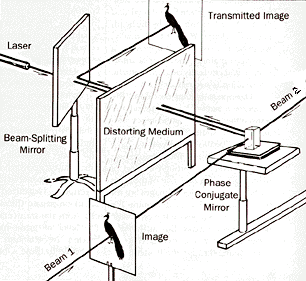
Consider the phenomenon of optical phase conjugation -- a process that can reverse the motion of a beam of light and cause an image scrambled by frosted glass to return to its original, undistorted form. In a typical experiment, light is reflected from an object and passes through a pane of frosted glass. It then reflects from a device called a phase conjugate mirror and passes back through the glass. When the light enters the eye, one perceives a clear, undistorted image of the original object. This can be contrasted with the garbled blur one would observe if the light were reflected back through the glass by an ordinary mirror. See Figure left.
The explanation of this phenomenon is that the light on its first pass through the frosted pane is distorted in a complicated way by irregularities in the glass. The phase conjugate mirror reverses the distorted beam, and as it passes back through the glass it precisely retraces its steps and thus returns to its original undistorted form.
The beam reflected from the phase conjugate mirror has the curious property that it encodes information for the original image in a distorted, unrecognizable form, and as time passes, the distortion is reduced and the information contained by the beam becomes clearly manifest. Normally, we expect to see just the opposite -- a pattern containing meaningful information will gradually degrade until the information is irretrievably lost.
Thompson further elucidates the connection between the material and transcendental levels of existence with an example similar to that of optical phase conjugation. Suppose we have an arrangement in which pictures are being transmitted through a sheet of frosted glass. On one side of the glass we would see a series of images but we would not be able to determine the source of the images on the other side of the opaque glass. But in thinking about it, one would expect that the light coming through the frosted glass would become distorted. The fact that it does not seems to indicate that there is some sort of intelligence which is organizing or ordering the transmitted images. This is a simplified example of optical phase conjugation. Similarly, the order and complexity we find in matter must have intelligence behind it, although we at present cannot directly see that intelligence. The Vedic conception states that a veil of illusion called maya prevents living beings in the material domain from directly perceiving their origin, Godhead -- the supreme intelligent being. The Vedas further maintain that although God predominates the material nature, He is manipulating it in such an expert way that His influence cannot be detected; as Bohm states, "Complex patterns of events seem to unfold simply by material action and reaction."
As Thompson progresses in the formulation of his Vedic paradigm, a number of questions arise. How are the postulated organized vibrations introduced into the known physical continuum? How can some outside influence be accommodated? This would seem to involve violations of certain basic laws of physics such as conservation of energy, the second law of thermodynamics, and statistical laws of quantum mechanics.
In response to these objections, Thompson postulates a model involving levels of physical reality more subtle than quantum fields. "One can readily imagine a hierarchy of subtler and subtler levels culminating in an ultimate substrate which is transcendental and not amenable to mathematical description. Organized wave patterns could propagate through this hierarchy from the transcendental level to the level of gross matter. In such models the quantum fields will be reducible to these subtler levels, and phenomena on these levels will have effects on the level of the quantum fields." In the transition from Newtonian physics to quantum mechanics and further to quantum field theory, the conceptual framework diverges from the domain of familiar mechanical imagery. Thompson suggests that "The degree of subtlety of a level of reality corresponds to the degree of novelty and unfamiliarity of the concepts needed to adequately comprehend it. On the subtlest (or transcendental) level, the materially inconceivable principle of achintya bheda bheda tattva becomes applicable."
According to the Vedic paradigm, the conscious self is transcendental and has the same qualitative nature as the Godhead. Thus the link between conscious will and the initiation of physical action by the brain should also entail the transmission of patterns of information from transcendental to gross physical levels of reality.
The introduction of wave patterns into the gross material realm from an outside independent source should produce detectable violations of the conservation laws of physics. It would not be surprising to find violations of known laws if such subtler levels of material energy do exist. Indeed, the existence of the neutrino was postulated by Enrico Fermi in the 1930's because of an apparent violation of the principle of conservation of momentum in the radioactive decay of certain atomic nuclei. The discovery of the neutrino showed the existence of a subtle level which was previously unknown. It is therefore entirely reasonable to speak of the existence of more subtle levels which are as yet undiscovered. Also, in his forthcoming book, Thompson shows that models which receive influences from more subtle levels without undergoing any detectable change in momentum or energy may be constructed.
Thompson suggests, "Let us suppose for the moment that organized wave patterns are continually being injected into the known physical continuum perhaps from subtler levels of physical reality. Such patterns will appear to be random, especially if they encode information for many different macroscopic forms and sequences of events. For this reason they will be very difficult to distinguish from purely random patterns by experimental observation."
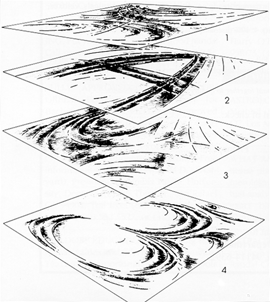
Consider a two-dimensional wave field -- exemplified by the surface of a body of water. This is illustrated in Figure 2, left. A two-dimensional wave field is capable of propagating waves which can be expressed by what is called the classical wave equation. In the first frame of Figure 2 we see the wave field moving in an apparently random way. As time passes it becomes apparent that this pattern of waves contains hidden information. This is illustrated in successive frames, where first in frame 2 we see that a letter "A" has appeared in the field. This form quickly takes shape and dissipates (frame 3), and it is replaced in frame 4 by the similar rapid appearance and disappearance of the symbol "" (Aum). Actually the information for both symbols is present in all 4 frames of the figure. This example is discussed in detail by Thompson in his forthcoming book:
Thus much of the random noise that surrounds us may consist of information for patterns that will 'unfold' in the future to produce macroscopic results, while the rest consists of the 'enfolded' or 'refolded' remnants of past macroscopic patterns.
Because the original source of these patterns is the inaccessible transcendental level, it is not possible to produce them at will. A thorough investigation of this phenomenon would necessarily depend on the analysis of observed spontaneous events.
Thompson believes that this type of study might be fruitful in the field of cognitive science. "According to the Vedic paradigm, the conscious self is transcendental and has the same qualitative nature as the Godhead. Thus the link between conscious will and the initiation of physical action by the brain should also entail the transmission of patterns of information from transcendental to gross physical levels of reality."
The concept of the unfolding of information is also useful in the field of natural history. The predominating scientific viewpoint is that the origin of living species can be explained by Darwin's theory of evolution by natural selection and random variation. Included in the group of those who have always dissented from this view is Alfred Russell Wallace, the co-inventor of Darwin's theory. Wallace felt that certain biological phenomenon, such as the brain, could not be accounted for properly without the action of some higher intelligence. Similarly, Bohm feels that "Natural selection is not the whole story, but rather that evolution is a sign of the creative intelligence of matter." Thompson has pointed out that "Bohm regards this intelligence as emanating either from his implicate order or from beyond."
The Vedic paradigm proposes that the supreme intelligent being can create or modify the forms of living beings by the transmission of organized wave patterns into the physical realm. Of course both this theory of creation by sound and the Darwinian theory of evolution are very difficult to verify. Thompson states, "The theory of creation by sound vibration involves transcendental levels of reality not accessible to the mundane senses, and thus in one sense it is more unverifiable than the purely physical Darwinian theory. However, if a purely physical theory turns out to be empirically unverifiable, then there is nothing further one can do to be sure about it. In contrast, a theory that posits a supreme intelligent being opens up the possibility that further knowledge may be gained through internal and external revelation brought about by the will of that being."
This entire approach is in line with the oft-mentioned need for a new paradigm, a new world view which is said to be in the making. Although the mechanistic world view founded by Descartes, Galileo, Newton, and Bacon has dominated thought since the seventeenth century -- now, as we approach the twenty-first century, the severe limitations of this view have become apparent. The mechanistic approach must be replaced with a holistic approach. Rather than torturing nature for her secrets, Thompson's idea calls for a reverence for nature and a humble appeal to Godhead for divine service.
Finally, in Thompson's own words, "This approach to knowledge and to life also constitutes one of the great perennial philosophies of mankind, but it has tended to be eclipsed in this age of scientific empiricism. To obtain the fruits of this path to knowledge, one must be willing to follow it, and one will be inclined to do this only if one thinks the world view on which it is based might possibly be true. Establishing this possibility constitutes the ultimate justification for constructing theories such as the one considered here: linking physics and metaphysics."
1) The Holographic Paradigm by Ken Wilber, p. 211-212.
This article was originally published on the Vedic Sciences website where you can read many more similar articles.
