

 OBJECTION: Madhva has said in his commentary to the Kathopanisad that there are nine types of offense to Lord Visnu, such as ascribing divinity to an ordinary mortal. You are guilty of this because you claim that Caitanya is an incarnation of God. The result of this is that you will go to the darkest regions of hell.
REFUTATION: There are many evidences to prove the divinity of Sri Caitanya Mahaprabhu. First we will present those statements of sastra which are from sruti, and then those from the Puranas and other Vedic literatures.
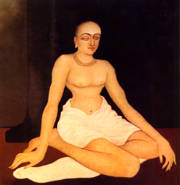
itotham krta sannyaso'vatarisyami sa-guno nirvedo
niskamo bhu-girvanas tira-atho' lakanandayah kalau
catuh-sahasrabdhopari panca-sahasrabhyantare
gaura-varno dirghangah sarva-laksana-yukta isvara-
prarthito nija-rasasvado bhakta-rupo misrakhyo
vidita-yogah syam
I will descend on the earth after the passage of four thousand years in the Kali-Age, and before the passsage of five thousand years. I will come on the earth on the bank of the Ganges,. I will be a tall and saintly brahmana devotee. I will have all the auspicious symptoms of an exalted person. I will exhibit renunciation. I will have all auspicious signs. I will be a devotee, practicing bhakti-yoga. I will taste the rasa of My own devotional service. (Atharva Veda)
saptame gaura-varna-visnor ity aena sva-saktya
caikyam etya pratar avatirya saha svaih sva-manum siksayati
In the seventh manvantara, in the beginning of the Kali-Yuga, the Supreme Personality of Godhead will, accompanied by His own associates, descend in a golden form to the earth. He will teach the chanting of His own names.
(Atharva-Veda Purusa-Bodhini-Upanisad 8)
tathaham krta sannyaso bhu-girvano 'vatarisye
tire'lakanandayah punah punah isvara-prarthitah sa-
parivaro niralambo nirdhuteh kali-kalmasa-kavalita-
janavalambanaya
I shall come to the earth, accompanied by My associates, in a place by the bank of the Ganges. I will advent to save the people who are afflicted and devoured by the sins of the age of Kali. I will manifest as an avadhuta Brahmana sannyasi. (Sama Veda)
mahan prabhur vai purusah
sattvasyaisa pravartakah
su-nirmalam imam praptim
isano jyotir avyayah
The Supreme Personality of Godhead is Mahaprabhu, who disseminates transcendental enlightenment. Just to be in touch with Him is to be in contact with the indestructible Brahmajyoti. (Svetasvatara Upanisad 3.12)
yada pasyah pasyate rukma-varnam
kartaram isam purusam brahma-yonim
One who sees that golden-colored Personality of Godhead, the Supreme Lord, the supreme actor, who is the source of the Supreme Brahman, is liberated. (Mundaka Upanisad 3.1.3)
asan varnas trayo hyasya
grhnato’nuygam tanuh
suklo raktastatha pita
idanim krsnatam gatah
"This boy Krsna, has three other colors: white, red and yellow as He appears in different ages. Now, in this Dvapara-yuga, He has appeared in a transcendental blackish color." (Srimad Bhagavatam 10.8.13)
dhyeyam sada paribhava-ghnam abhista-doham
tirthaspadam siva-virinci-nutam saranyam
bhrtyarti-ham pranata-pala bhavabdhi-potam
vande maha-purusa te caranaravindam
We offer our respectful obeisances unto the lotus feet of Him, the Lord, upon whom one should always meditate. He destroys insults to His devotees. He removes the distresses of His devotees and satisfies their desires. He, the abode of all holy places and the shelter of all sages, is worshipable by Lord Siva and Lord Brahma. He is the boat of the demigods for crossing the ocean of birth and death. (Srimad Bhagavatam. 11.5.33)
tyaktva sudustyaja-surepsita-rajya-laksmim
dharmistha arya-vacasa yad agad aranyam
maya-mrgam dayitayepsitam anvadhavad
vande maha-purusa te caranaravindam
"We offer our respectful obeisances unto the lotus feet of the Lord, upon whom one should always meditate. He left His householder life, leaving aside His eternal consort, whom even the denizens of heaven adore. He went into the forest to deliver the fallen souls, who are put into illusion by material energy." (Srimad Bhagavatam. 11.5.34)
krsna varnam tvisa krsnam
sangopangastra parsadam
yajnaih sankirtanam-prayair
yajanti hi sumedhasah
"In the age of Kali, Krsna appears in a golden form, chanting the two syllables krs-na. He descends along with His weapons, saktis, limbs, and eternal confidential associates. Those with intelligence worship Him with the sankirtana yajna.
(1) (Srimad Bhagavatam 11.5.32)
ittham nr-tiryag-rsi-deva-jhasavatarair
lokan vibhavayasi hamsi jagat-pratipan
dharmam maha-purusa pasi yuganuvrttam
channah kalau yad abhavas tri-yugo ’tha sa tvam
"My Lord, You kill all the enemies of the world in Your multifarious incarnations in the families of men, animals, demigods, rsis, aquatics and so on. Thus You illuminate the worlds with transcendental knowledge. In the Age of Kali, O Mahapurusa, You sometimes appear in a covered incarnation. Therefore You are known as Tri-yuga [one who appears in only three yugas]." (Srimad Bhagavatam. 7.9.38)
aham eva dvija-srestha
nityam pracchana-vigrahah
bhagavad-bhakta-rupena
lokan raksami sarvada
"O best of the brahmanas, My disguised form is eternal. In this way, with My own form hidden from ordinary sight I take the form of a devotee and appear among the people in general in order to establish and protect religious principles." (Adi Purana)
aham eva kvacid brahman
sannyasa asramam asritah
hari bhaktim grahayami
kalau papa-hatan naran
‘O Brahmana, I occasionally take the sannyasa asrama in an attempt to bring the fallen people of Kali Yuga to take up the path of bhakti or devotional service to Lord Krsna. (Upa-purana)
kalina dahyamanam
uddhararaya tanu-bhrtam
janma prathama sandhyayam
bhavisyati dvijalaye
The Supreme Person will appear in the first part of the age of Kali. He will appear in the home of a brahmana to save the embodied conditioned souls burning in the troubles of Kali-Yuga. (Kurma-Purana)
kalina dakyamananam
paritranaya tanu-bhrtam
janma prathama sandhyayam
karisyami dvijatisu
aham purno bhavisyami
yuga-sandhyau visesatah
mayapure navadvipe
bhavisyami saci sutah
kaleh prathama sandhyayam
lakshmi- kanto bhavisyati
daru-brahma-samipa-sthah
sannyasi gaura-vigrahah
In the first part of the age of Kali, I will come among the brahmanas to save the fallen souls, who are being burned by the troubles of the age of Kali.
I will take birth as the son of Saci, in Navadvipa-Mayapura.. I will come in my complete spiritual form in the first part of Kali-Yuga.
In the first part of Kali-Yuga, the Supreme Personality of Godhead will come in a gold-like form. First He will become the husband of Laksmi (Srimati Laksmi Devi, Lord Caitanya's first wife). Then He will become a sannyasi, near Lord Jagannatha who will appear in a divine wooden form. (Garuda-Purana)
satye daitya-kuladhi-nasa-samaye
simhordhva-martyakrtis
tretayam dasa-kandharam
paribhavan rameti namakrtih
gopalan paripalayan vraja-pure
bharam haran dvapare
gaurangah priya-kirtanah
kali-yuge caitanya-nama prabhuh
"The Supreme Personality of Godhead who in the Satya-yuga appeared as a half-man, half-lion to cure a terrible disease that had ravaged the daityas, and who in the Treta-yuga appeared as a person named Rama (Lord Ramacandra), a person who defeated the ten- headed Demon Ravana, and who in the Dvapara-yuga removed the earth's burden, and protected the Gopa (cowherd men) people of Vraja-pura, will appear again in the Kali-yuga. His form will be golden, He will delight in chanting the Lord's holy names, and His name will be Caitanya." (Nrsimha Purana)

yatrayogesvarah saksad
yogi-cintyo janardanah
caitanya vapur aste vai
sandranandatmakah
kaleh prathama-sandhyayam
gaurangotham mahi-tale
bhagirathi-tate ramye
bhavisyami saci-sutah
The Supreme Personality, Janardana, who is the object of the yogis' meditation, who saves the devotees from various sufferings, and who is the master of all yogic practices, who is always full of divine transcendental ecstasy and bliss, will advent in His own divine form of Sri Caitanya.
I shall appear on this earth in the first part of Kali-yuga in a beautiful place on the bank of the Bhagirathi. I shall have a golden form, and I shall take birth as the son of Saci. (Padma-Purana)
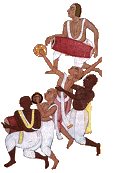
aham eva kalau vipra
nityam prachanna-vigrahah
bhavavad-bhakta-rupena
lokan raksami sarvada
divija bhuvi jayadhvam
jayadhvam bhakta rupinah
kalau sankirtana rambhe
bhavisyami saci-sutah
aham eva dvija-srestho
nityam pracchanna-vigrahah
bhagavad-bhakta-rupena
lokam raksami sarvada
O Vipra, in the age of Kali, I will come disguised as a devotee and I will save all the worlds.
O Divija (demigods), please come and advent as devotees on this earth in the age of Kali-yuga. I will incarnate as the son of Saci to inaugurate the congregational chanting of the name of Krsna.
I shall advent in the form of a brahmana devotee and I shall hide my factual identity. I shall deliver all the worlds. (Narada Purana)
kaleh prathama sandhyayam
gaurangotham mahi-tale
bhagirathi-tate bhumni
bhavisyami saci-sutah
I will reveal my eternal golden form in the first part of Kali-yuga. I will advent on the earth on the bank of the Bhagirathi. (Brahma-Purana)
anandasru-kala-roma
harsa-purnam tapo-dhana
sarve mama eva draksyanti
kalau sannyasa-rupinam
O austere sage, you should know that in the age of Kali, everyone will see my transcendental form as a sannyasi. I will be exhibiting symptoms of ecstasy like shedding tears of bliss and hairs standing in ecstasy. (Bhavisya-Purana)
prasantatma lamba-kanthas gaurangas ca suravrtah
The Supreme Personality of Godhead will come in a golden form, full of peace, and a beautiful long neck. He will be surrounded by many saintly devotees. (Agni-Purana)
mundo gaurah su-dirghangas
tri-srotas-tira-sambhavah
dayaluh kirtana-grahi
bhavisyami kalau-yuge
In the age of Kali, I shall advent where the three rivers meet. I shall have a shaven head. I shall have a golden complexion. I will be very kind and always chant the holy name of Krsna. (Matsya-Purana)
golokam ca parityajya
lokanam trana-karanat
kalau gauranga-rupena
lila-lavanya-vigrahah
In the Kali-Yuga, I will leave Goloka and, to save the people of the world, I will become the handsome and playful Lord Gauranga. (Markandeya-Purana)
aham eva dvija-srestho
lila-pracurya-vigrahah
bhagavad-bhakta-rupena
lokan raksami sarvada
I shall come as the best of the brahmanas. I will exhibit many pastimes in the form of a devotee. I shall deliver the people of the world. (Varaha-Purana)
kali-ghora-tamas-channat
sarvan acara varjitan
sacigarbhe ca sambhuya
tarayisyami narada
O Narada Muni, I will take birth in the womb of Saci. I shall save the people, who will give up all proper good conduct, from the terrible darkness of the age of Kali-Yuga. (Vamana-Purana)
paurnamasyam phalgunasya
phalguni-rksa-yogatah
bhavisye gaura-rupena
saci-garbhe purandarat
svarnadi-tiram asthaya
navadvipe janasraye
tatra dvija-kulam prapto
bhavisyami janalaye
bhakti-yoga-pradanaya
lokasyanugrahaya ca
sannyas-rupam asthaya
krsna-caitanya-nama-dhrk
tena lokasya nistaras
tat kurudhvam mamajnaya
dharitri bhavita cabhir
mayaiva dvija-dehina
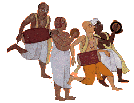
I shall advent in the month of Phalguna, when the star Phalguni is conjoined with the full moon. I shall incarnate in a golden complexion in the womb of Saci and Purandara Misra.
I will be born in the city of Navadvipa, on the Ganges' shore, in a Brahmana's family. I shall take the renounced order of life (sannyasa) and show kindness to the people in general and engage them in bhakti. I will be known as Sri Krsna Chaitanya.
All of you should follow My order and deliver the people of the world. I shall appear as a Brahmana. I shall make this earth fearless. (Vayu-Purana)
suddho gaurah-su-dirghango
ganga-tira-samudbhavah
dayaluh-kirtana-grahi
bhavisyami kalau yuge
In the age of Kali-yuga, I shall come in a place on the bank of the Ganges. I will be very pure, have a fair complexion, and be very tall and chant the holy names of Krsna.
(Vayu-Purana)
kalau sankirtanarambhe bhavisyami saci-sutah
"In the Age of Kali when the sankirtana movement is inaugurated, I shall descend as the son of Sacidevi." (Vayu Purana).
suvarna-varno hemango
varangas-candanangadi
"He appears in a golden form, His limbs are the complexion of molten gold. His body is extremely beautiful and decorated with sandalwood pulp."
(Mahabharata, Visnu Sahasranama)
sannyasa-krcchamah santo
nistha santi-parayanah
"He accepts sannyasa and shows equanimity. He is peaceful. His mind is always fixed and He performs chanting." (Mahabharata, Visnu Sahasranama)
svarnadi-tiram asritya
navadvipe dvijalaye
sampradatum bhakti-yogam
lokasyanugrahaya ca
sa eva bhagavan krmo
radhika-prana-vallabhah
srsty-adau sa jagannatho
gaura asin mahesvari
avatirno bhavisyami
kalau-nija-ganaih saha
saci-garbhe navadvipe
svardhuni-parivarite
aprakasyam idam guhyam
na prakasyam bahir mukhe
bhaktavataram bhaktakhyam
bhaktam bhakti-pradam svayam
man-maya-mohitah kecin
na jnasyanto bahir-mokhah
jnasyanti mad-bhakti-yuktah
sadhavo-nyasinotmalah
krmavatara-kale-yah
striyo ye purusah priyah
kalau te'vatarisyanti
sridama-subaladayah
catuh-sasti-mahantas te
gopa dvadasa balakah
caitanyera simhera...
dharma-samsthapanarthay
a viharisyami tair aham
kale nastam bhakti-patham
sthapayisyamy aham punah
gacchantu bhuvi te putrah
jayantam bhakta-rupinah
dharma-samsthapanam kale
kurvantu te mamajnaya
krsnas caitanya-gaurango
gauracandrah saci-sutah
prabhur gauro gaura-harir
namani-bhakti-dani me
To show mercy to the people and give them devotional service, the Supreme Personality of Godhead will appear in a Brahmana's home in Navadvipa by the Ganges's shore. The Supreme Person, Sri Krsna Himself, who is the life of Srimati Radharani, and is the Lord of the universe in creation, rnaintenance, and annihilation, appears as Gaura, O Mahesvari.
In Kali-yuga, I will descend to the earth with My associates. In Navadvipa, which is surrounded by the Ganges, I will take birth in Saci-devi 's womb.
They who are bewildered by My illusory potency will not understand the great secret of the appearance in this world of Me in My personal form, in My form as the incarnation of devotion, in My form as the incarnation of a devotee, in My form bearing the name of a devotee, in My form as a devotee, and in My form as the giver of devotional service.
This secret is not to be revealed to them. Only the saintly, pure, renounced devotees, diligently engaged in My devotional service, will be able to understand Me in these five forms.
My dear male and female associates, headed by Sridama and Subala, who came to this world at the time of My advent as Lord Krsna, will come again during the Kali-yuga.
The Gopas will become the sixty-four mahantas and the twelve gopalas. To establish the truth of religion, I will enjoy many pastimes with them.
In this way I will again reveal the path of devotional service, which has been destroyed in the course of time. My sons should also descend to the earth, assume the forms of devotees, and, by My order, also work to re-establish the principles of true religion.
At this time My names will be: Krsna Chaitanya, Gauranga, Gauracandra, Sacisuta, Mahaprabhu, Gaura and Gaurahari. Chanting these names will bring devotion to Me. (Ananta-Samhita)
punya-ksetre navadvipe bhavisyami saci-sutah.
"I shall appear in the holy land of Navadvipa as the son of Sacidevi."
(Krsna-yamala-Tantra)
atha vaham dharadhame
bhutva mad-bhakta-rupa-dhrk
mayayam ca bhavisyami
kalau sankirtanagame
"Sometimes I personally appear on the surface of the world in the garb of a devotee. Specifically, I appear as the son of Saci in Kali-yuga to start the sankirtana movement." (Brahma-yamala Tantra)
The challenging party may question Mahaprabhu's divinity, yet it behooves them to to prove, through unbiased evidence, how they conclude that Sri Jaya Tirtha is the incarnation of Madhvacarya's pack-bull, Sri Raghavendra is the incarnation of Prahlada, Sri Vadiraja is the incarnation of Rukmini's brahmana messenger and Purandara Dasa is the incarnation of Narada.
OBJECTION: Some of the scriptures that you quote have never been heard of.
REFUTATION: For acaryas to quote from fictitious scriptures when living in an environment of highly learned panditas, seems both incredulous and highly improbable. Therefore we may surmise from this that many of these unknown books were lost in time, including editions of puranas which are different to those we are familiar with today.
 There are many instances where Acarya Madhva quotes from sources that are unheard of. For example, Upagita, Kamatha Sruti, Karmaviveka, Kalapa Sruti, Tantra-prakasika, Kapileya Samhita, Karanaviveka, Kausika Sruti, Gatisara, Adhara, AruniSruti, Upanaradiya, Ubhayanirukta, Indraduymna Sruti, Upasana Laksana, Jivatattva, Gunaparama, Gitasara, Gitakalpa, Guruviveka, Gautamakhila, Jyotis Samhita, Tattvasara, Tattvodyoga, Tantra Bhagavata, Tantra Mala, Triyoga, Nibandha, Prana Samhita, Muktitattva, Yadavadhyatama, Linganirnaya, Mahodadhi, Vicara, Viparita Sruti, Visvambhara Sruti, Vimala Samhita, Vaibhavya, Vaisesya, Visva Tantra, Lokatattva, Vayuprokta, Vallabhya, Boddhavya, Pravrtta Samhita, Pavamaniya Vijaya, Pautrayana Sruti, Purusottama Tantra, Vimarda Sruti, Sumata, Sadgunya, Pippalada Sruti, Kathaka Sruti, Paingini Sruti, and Sauparna Sruti to name but a few. It may be argued that in the time of Madhva the sources of his scriptural references were never disputed by his opponents.
Similarly we may use the same line of reasoning — that at the time when our acaryas quoted such ‘spurious’ books and verses to establish Mahaprabhu’s divinity, no anti-party came forward to deny the authenticity of these quotes and their origin.
OBJECTION: Many of your scriptural quotes are not to be found in the said books.
REFUTATION: Sri Madhvacarya also quotes scriptural verses that cannot be found. Two instances of this are found in his Visnu Tattva Vinirnaya, wherein he quotes the following from Skanda Purana —
ajnanam jnanado visnuh
jnaninam moksadas ca sah
anandadas ca muktanam
sa aiveko janardanah
"The Supreme Lord Janardana gives knowledge to the ignorant, liberation to the enlightened and bliss to the liberated."
And from the Padma Purana —
nrpadya satavrtyanta
muktiga uttarottaram
gunaih sarvaih sataguna
modanta iti hi srutih
"From Manusyottama upto Brahma, all enjoy the bliss multiplied by hundred in an ascending order, thus the sruti declares."
Neither of these slokas are to be found in the said books! The same peculiarity is found in other works of the acarya such as his Gita Bhasya, Mahabaharata Tatparya and Bhagavata Tatparya. Should we then assume that Sri Madhva has quoted fictitious verses?
OBJECTION: Those quotes that you use which can be found are conveniently interpreted by you to promote the cause of your own sect.
REFUTATION: This is consistent within the sampradayika tradition and those within that school are satisfied. However, those outside that fold may not accept such interpretations. For example, you accuse the Gaudiyas of misinterpreting verses to suite their own purpose in establishing the divinity of Mahaprabhu, yet you have done exactly the same, quoting the Balittha Sukta (2) as evidence to show your acarya as the incarnation of Mukhya Prana. So with this line of reasoning, you discredit your own Madhva line.
OBJECTION: But Madhva himself asserts his identity in many instances; one of them is in his Visnu-tattva-vinirnaya:
yasya trinyuditani vedavachane rupani divyanyalam
bah tad darsatamitthameva nihitam devasya bhargo mahat
vayo ramavaconayam prathamaka prkyo dvitiyam vapuh
madhvo yattu trtiyametadamuna granthah krtah kesave |
"The Deity whose three divine forms are spoken of in the Vedas, as one whose nature is that of great wisdom and ability, is the support of the activity of the worlds, is very worshipful (of Visnu), and who incarnates with his full potency (with no diminution); that Vayu, in his first avatara, carried the message of Rama, destroyed a fearsome army in his second, and in the third, as Madhva, composed this work (the Visnu-tattva-vinirnaya) as a service to Kesava."
REFUTATION: This may well be, but how can we accept the writings of your acarya and his followers to prove such a point? Where is the neutral evidence based on Vedic scriptures? Do you have direct proof from the Puranas, Agamas, Upanisads or Vedas? All you can point at is one veiled statement, interpreted to promote the cause of your own sect.’
OBJECTION: It is the opinion of learned scholars such as Trivikrama Panditacarya that Madhva was the incarnation of Mukhya Prana (Vayu).
REFUTATION: It is also the learned opinion of great scholars such as Vasudeva Sarvabhauma, Kesava Bhatta, Prakasananda Sarasvati, Prabodhananda Sarasvati, Advaita Acarya, Srivasa Pandita, Gopala Bhatta Gosvami, Rupa Gosvami, Sanantana Gosvami, Jiva Gosvami, Raghunatha Dasa Gosvami, Raghunatha Bhatta Gosvami, Raya Ramananda, Nilambara Cakravarti, and Gopinatha Acarya that Sri Chaitanya Mahaprabhu was Sri Krsna Himself. It was also the opinion of Rajarsi Prataparudra of Kalinga and his guru Kasi Misra.
OBJECTION: In reference to Madhva’s being an incarnation of Vayu, there is no opportunity for exaggeration in the ‘Sumadhva Vijaya’ because the authentic history recorded in Madhva’s own lifetime has remained unchanged to this day. Although there are several different biographical texts of other sampradayika acaryas, they tend to conflict with each other, or were written a long time after the incidents occurred.
Therefore there is either very little or no support from physical evidence. ‘Sumadhva Vijaya’ was written by a contemporary of Madhvacarya and does not have to compete with any other text to assert it’s authority.
REFUTATION: Because there is no other record of Madhva’s life apart from ‘Sumadhva Vijaya’, what proof do we have that the writer did not exaggerate? When writing a kavya, the poet is prone to use dramatic license (alankara) to enhance the qualities of the principal personality that he glorifies. How can we be so certain that your Narayana Panditacarya did not follow this trait, while you at the same time are accusing us of such.
Many biographies such as Kaviraja Gosvami’s Chaitanya Caritamrta, Vrndavana Dasa Thakura’s Chaitanya Bhagavata, Locana Dasa Thakura’s Chaitanya Mangala and Kavi Karnapura’s Chaitanya Candradaya were written about the life of Sri Chaitanya Mahaprabhu. While some accounts differ on some details of His lilas, on the point of His divinity they are all unanimous.
OBJECTION: But Narayana Panditacarya writes in his ‘Bhavaprakasa tika’ on ‘Sumadhva Vijaya’ -
maya drsta bhuvamiti proktah prayena purusaih
dvayor vaktror virodhe’tra svikrta prabalasya gih
tulyam tu suksmam drst vadyau (tulye tatsuksmadrstyadyau)
deve (daive) naiva pariksyate
"The incidents reported are mostly from those who were actually present thus, ‘ I have seen it with my own eyes.’ Where there are contradictory statements, the more forceful among the two has been accepted. When they are equally weighty, discretion is allowed to decide the matter."
kavyasriyah va gurukirtaye va
proktam svayaivapi manisyeti
tasmann sankayeta mahajane’smin
pumsa kusagriyadhiya’pyavasyam
"Therefore people should not mistrust the material that has been presented, thinking that it is self-fabricated to exaggerate the glories of one’s guru, or to show off one’s talents in poetry."
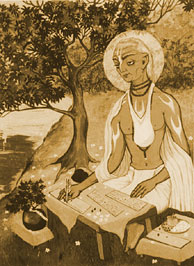
REFUTATION: Similarly the followers of Sri Chaitanya say that the facts presented by Srila Kaviraja Gosvami in Sri Chaitanya Caritamrta are authentic because they are taken from the personal diaries of Sri Murari Gupta and Sri Svarupa Damodara Gosvami, two intimate associates of Mahaprabhu. The diaries are still available and it would be absurd to argue that someone would exaggerate or lie when writing a personal diary.
When Vrndavana Dasa Thakura wrote his Chaitanya Bhagavata, many personal associates of Mahaprabhu were still physically present. The fact that Chaitanya Bhagavata was accepted as a genuine biography by all of these associates is proof that the events therein are not exaggerated or false.
In fact, the Gaudiyas accept Madhvacarya as the incarnation of Vayu and respect the exalted position of Narayana Panditacarya and his biography of Madhva. However, as stated before we are using such arguments to show that such logic can work both ways.
We may now present a question to our Tattvavadi friends — what is the yuga-dharma and who is the yuga-avatara?
The following quotes are presented thus:
kalim sabhajayanty arya
guna jnah sara-bhaginah
yatra sankirtanenaiva
sarva-svartho ’bhilabhyate
"Those who are actually advanced in knowledge are able to appreciate the essential value of this age of Kali. Such enlightened persons worship Kali-yuga because in this fallen age all perfection of life can easily be achieved by the performance of sankirtana."
(Srimad Bhagavatam 11.5.36)
kaler dosa-nidhe rajann
asti hy eko mahan gunah
kirtanad eva krsnasya
mukta-sangah param vrajet
krte yad dhyayato visnum
tretayam yajato makhaih
dvapare paricaryayam
kalau tad dhari-kirtanat
"The most important factor in this Age of Kali, which is an ocean of faults, is that one can be free from all contamination and become eligible to enter the kingdom of God simply by chanting the holy names. The self-realization that was achieved in the Satya millennium by meditation, in the Treta millennium by the performance of different sacrifices, and in the Dvapara millennium by worship of Lord Krsna can be achieved in the Age of Kali simply by chanting the holy names." (Srimad Bhagavatam 12.3.51-2)
dhyayan krte yajan yajnais-
tretayam dvapare rcayan
yadapnoti tadapnoti
kalau samkirtaya kesavam
"The supreme goal which was attained in Satya-yuga by years of prolonged meditation; in Treta-yuga by performing extensive yajnas; in Dvapara-yuga by opulent and scrupulous Deity worship; in Kali-yuga the same results are easily had simply by the chanting of the holy name." (Visnu Purana)
harer nama harer nama
harer namaiva kevalam
kalau nasty eva nasty eva
nasty eva gatir anyatha
"In this age of quarrel and hypocrisy the only means of deliverance is chanting of the holy name of the Lord. There is no other way. There is no other way. There is no other way." (Brhad Naradiya Purana)
harinama para ye ca
ghore kali-yuge narah
te eva krtakrtyasca
na kalir badhate hi tan
hare kesava govinda
vasudeva jaganmaya
itirayanti ye nityam
na hi tam badhate kalih
"In this dark age of Kali-yuga, sincere devotees of the Supreme Lord should leave aside all other means for liberation and take full shelter of the holy name. This is their real responsibility and duty. There is unlimited bliss in chanting the different names of Krsna: Hari, Kesava, Govinda, Vasudeva and Jaganmaya. For one who chants constantly with unflinching faith, he remains unaffected by the reverses of Kali-yuga, because his heart has become purified by chanting." (Brhan-naradiya Purana)
hari-nama-para ye ca
hari-kirtana tat parah
hari-puja-para ye ca
te krtarthah kalau-yuge
"Those who engage in chanting the holy name of Lord Hari (japa), are addicted to congregational chanting (kirtana) and engage in the worship of Lord Hari, have accomplished their desires in the age of Kali." (Brhan-naradiya Purana)
dhyayan krte yajan yajnais
tretayam dvapare ’rcayan
yad apnoti tad apnoti
kalau sankirtya kesavam
"Whatever is achieved in Satya-yuga by meditation, in Treta by offering ritual sacrifices and in Dvapara by temple worship is achieved in Kali-yuga by chanting the names of Lord Kesava congregationally." (Padma Purana, Uttara Khanda 42nd Chapter)
satyam kaliyuga vipra
sri harer nama mangalam
param svastyayanam nrnam
nasty-eva gatir anyatha
"Oh brahmana, chanting of the holy name is the auspicious process in Kali Yuga. It is the highest auspiciousness for mankind. There is no other way." (Padma Purana)
krsna krsneti krsneti
svapan jagrad vrajamstatha
yo jalpati kalau nityam
krsna-rupi bhaveddhi sah
"Whoever continuously chants Lord Krsna's holy name, even in his sleep, can easily realise that the name is a direct manifestation of Krsna Himself, in spite of the influences of Kali-yuga. This has been ordained by Lord Krsna. (Varaha Purana)
kali-kala kusarpasya
tiksna-damstrasya ma bhayam
govinda-nama-danena
dagdho yasyati bhasmatam
"I see that Kali-yuga is like a black, poisonous snake with a gaping mouth and fangs. But please be unperturbed dear devotees and listen with faith. Once the holy name of the Lord is being chanted, it is like igniting a forest fire which will burn to ashes the poisonous snakes within the forest. (Skanda Purana)
mahabhagavata nityam
kalau smakirtaya kesavam
"The hallmark of a mahabhagavata the most elevated devotee in Kali-yuga is that he chants the holy name of the Lord constantly. (Skanda Purana)
varjams-tisthan svapannasnan
svasan vakya-prapurane
nama-samkirtanam visnor-
helaya kali-vardhanam
krtva svarupatam yati
bhakti-yuktam param vrajet
"In our normal activities of eating, sleeping, sitting, dreaming, etc. to chant Krsna's names, while nullify the ill effects of Kali-yuga, is the perfection of speech. Even it a person chants Krsna's names indifferently, he will surely achieve his svarupa, or original spiritual self and attain that state beyond all material fear and lamentation. He will reach Vaikuntha, the supreme goal. (Linga Purana)
hare krsna hare krsna
krsna krsna hare hare
hare rama hare rama
rama rama hare hare
iti sodasakam namnam
kali-kalmasa-nasanam
natah parataropayah
sarva-vedesu drsyate
"After searching through all the Vedic literature one cannot find a method of religion more sublime for this age than the chanting of Hare Krsna." (Kali Santarana Upanisad)
And finally, Madhva himself, quoting Narayana Samhita, in his Mundakopanisad Bhasya says
dvapariyair janair visnuh
pancaratrais tu kevalam
kalau tu nama-matrena
pujyate bhagavan harih
"In the Dvapara-yuga people should worship Lord Visnu only by the regulative principles of the pancaratra and other such authorized books. In the Age of Kali, however, people should only chant the holy names of the Supreme Personality of Godhead."
 CONCLUSION: Therefore it is clear that the yuga-dharma in this age is Hari-nama sankirtana, as proclaimed in the above Vedic references. Furthermore, the above verses clearly describe that the advent and purpose of Sri Caitanyadeva's appearance is to propogate the yuga-dharma Hari-nama sankirtan. Further authentication is found in the recorded biographies of the intimate associates of Sri Chaitanya Mahaprabhu. (3)
________________________________
(1) The words krsna-varnam mean two things – firstly they indicate that Sri Chaitanya is of the same category (varna) as Sri Krsna. Secondly it also refers to one who constantly chants the name of Krsna.
(2) balittha tad vapusedhayi darsatam devasya bhargah sahaso yato ajani /
yadimupahvarate sadhate matir-rtasya dhena anayanta sasruta //
prkso vapuh pitumannitya asaye dvitiyamasaptasivasu matrsu /
trtiyamasya vrsabhasya dohase dasapramatim janayantayosanah //
niryadim budhnanmahisasya varpasa isanasah savasa krantasurayah /
yadimanupradivo madhva adhave guhasantam matarisva mathayati //
prayatpituh paramanniyateparyaprksudho virudho dansu rohati /
ubhayasya janusam yadinvata adidyabistho abhavadhdhrna sucih //
adinmatravisadyasva sucirahimsyamana urviya vivavrdhe /
anuyatpurva aruhastanajuvoni navyasisva varasu dhavate // ( Rg Veda 1.141.1-5)
(3) For further information readers are referred to Sri Gaura Gayatri Vijaya by Sripad B. G. Narasingha Maharaja.